
Why Does Your Motorcycle LCD Look Different When You View It from an Angle?
Imagine a motorcycle manufacturer evaluating a new digital instrument cluster.
During a meeting, the TFT LCD looks clear and colorful when viewed directly from the front. The resolution is suitable, the brightness meets the initial target, and the datasheet describes the display as having a wide viewing angle.
But after the display is installed on the motorcycle, an engineer notices something unexpected.
When looking down at the dashboard from the normal riding position, certain colors appear different. Dark backgrounds look lighter, and some warning icons seem less distinct.
What happened? Is the LCD defective, or is there something important missing from the display specification?
Real Customer Question:
“Our TFT LCD has a wide viewing angle, so why do the colors and contrast still change when the rider looks at it from above?”
This question introduces an important part of LCD optical design: Optical Compensation Films.
These films help manage how polarized light travels through the display at different viewing angles. Their role is not simply to make an LCD look wider, but to help improve the optical performance that users actually experience.
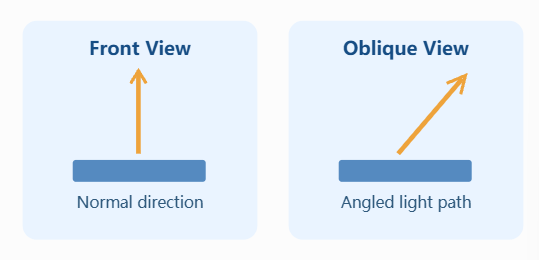
01 | The Real Viewing Angle Is the Rider’s Viewing Angle
A motorcycle instrument cluster is not viewed in the same way as a laptop screen on a desk.
The display is mounted at a fixed angle within the dashboard, while the rider’s eye position changes with body height, riding posture, and vehicle design.
Even if the LCD looks excellent when tested from directly in front, the actual rider may see it from an elevated or oblique position.
Scenario 1: The Display Looks Clear in the Laboratory but Different on the Motorcycle
An engineer evaluates the LCD on a flat test bench. Later, the same module is installed at an angle inside the vehicle. The rider notices lower contrast in some dashboard graphics.
In this situation, the team should review more than the published maximum viewing angle.
Important information includes:
- The display installation angle.
- The normal eye position of the rider.
- Viewing direction from above, below, left, and right.
- Contrast and color behavior at the intended angles.
- Ambient light reflections from the cover glass.
Engineering Insight: A display should be evaluated from the positions where people actually use it, not only from the front.
02 | Why Can an LCD Change Color at an Angle?
Unlike a simple transparent window, an LCD controls light through a system of liquid crystal molecules and polarizers.
The optical behavior of the liquid crystal layer depends on the polarization of light and the direction in which it travels through the material.
When the display is viewed from a different angle, the effective optical path changes. This can alter the light’s polarization state and the amount of light that passes through the display.
Depending on the panel structure, several effects may become visible:
- Color Shift: A color looks different from its front-view appearance.
- Contrast Reduction: Dark and bright areas become less distinguishable.
- Off-Axis Light Leakage: Dark areas appear brighter from certain angles.
- Gray-Level Changes: Some gray tones change appearance or become harder to distinguish.
- Luminance Variation: The perceived brightness changes with viewing direction.
These effects do not occur equally in every LCD. Their severity depends on the liquid crystal mode, polarizers, optical compensation design, and viewing conditions.
03 | What Is an Optical Compensation Film?
An Optical Compensation Film is an optical film engineered to modify the polarization and phase relationship of light passing through a display.
It may also be described as a Retardation Film or Phase Compensation Film.
Liquid crystal materials are birefringent, meaning that different polarization components of light can experience different refractive indices.
This creates a phase difference, or optical retardation.
A properly designed compensation film introduces an additional optical effect that helps counteract selected unwanted phase changes at particular viewing directions.
Technical Principle, Made Simple:
The liquid crystal layer changes the polarization state of light. An optical compensation film is designed to help correct certain angle-dependent changes, improving the overall viewing performance of the LCD.
The exact compensation depends on the material’s birefringence, optical axis orientation, thickness, wavelength behavior, and the LCD structure.
That is why optical compensation films are not interchangeable accessories that can simply be added to every existing display.
04 | Does Optical Compensation Mean the Screen Will Never Show Color Shift?
No.
Optical compensation is an engineering technique used to reduce particular optical problems. It does not eliminate every viewing-angle limitation.
For example, a design that improves dark-state contrast at certain angles may still show changes in color or brightness elsewhere.
Different LCD modes and compensation structures also behave differently.
The goal is to optimize the optical performance for the intended application, rather than promise identical appearance from every possible direction.
Scenario 2: A Motorcycle Dashboard Uses Dark Backgrounds with Colorful Warning Icons
A dark dashboard may look excellent when viewed straight on. But at an angle, light leakage or color changes can make warning indicators less distinct. The engineering team should compare the actual contrast and color performance at the rider’s viewing position.
For safety-related information, the complete system design should also consider graphic size, color choices, contrast, ambient light, and applicable vehicle requirements.
05 | IPS, VA, and TN: Do They Need the Same Optical Compensation?
IPS, VA, and TN describe different liquid crystal operating modes. Each has its own optical characteristics.
As a result, their viewing-angle behavior and suitable compensation methods can differ.
| LCD Mode | Viewing Consideration | Optical Design Focus |
|---|---|---|
| TN | Some viewing directions may show stronger contrast or gray-level changes. | Improve angle-dependent optical behavior. |
| VA | Oblique viewing may influence dark-state contrast and color. | Reduce off-axis light leakage and optical variations. |
| IPS | Generally wide viewing angles, but color and contrast can still vary. | Refine off-axis contrast and color performance where needed. |
It is important not to confuse a display mode with an optical film.
IPS is a liquid crystal operating mode. Optical compensation refers to the design of additional optical phase control within the display system.
Not every IPS, VA, or TN module uses the same film construction, and a product’s exact optical stack should be confirmed from the approved specifications.
06 | Does a 178-Degree Viewing Angle Guarantee Accurate Colors?
A wide viewing-angle figure can be useful, but the number alone does not tell the complete story.
Some LCD datasheets define viewing angle using a contrast-ratio threshold, such as a contrast ratio greater than 10:1.
However, a display may meet that threshold while showing noticeable changes in color, brightness, or black-level appearance.
Therefore, a specification such as 178 degrees does not automatically mean that the picture remains visually identical throughout that range.
Scenario 3: Two LCD Suppliers Both Advertise Wide Viewing Angles
Supplier A and Supplier B provide similar viewing-angle figures. But one display looks more consistent when the motorcycle rider views it from above. Which specification should the customer compare next?
The answer is to review the optical performance at the intended viewing angles, not only the maximum angle printed in the brochure.
Useful comparison items include:
- Up, down, left, and right viewing-angle limits.
- The contrast-ratio threshold used to define those limits.
- Color shift at selected viewing directions.
- Brightness and contrast variation.
- Dark-state performance and any relevant light leakage.
Procurement Insight: When comparing LCD suppliers, request the measurement definitions and application-relevant results rather than treating a single wide-angle number as a complete quality ranking.
07 | How Is Optical Compensation Different from AG, AR, and OCA?
Several optical technologies can improve the viewing experience of a motorcycle dashboard, but they work in different ways.
| Technology | Main Function |
|---|---|
| Optical Compensation Film | Helps improve angle-dependent LCD optical performance. |
| AG Anti-Glare | Scatters reflected light to reduce distracting glare. |
| AR Anti-Reflection | Reduces surface reflectance using suitable optical treatments. |
| AF Anti-Fingerprint | Helps reduce smudging and improve cleaning. |
| OCA Optical Bonding | Reduces selected internal air interfaces through transparent bonding. |
For example, if a display has strong reflections from the cover glass, optical compensation films are not a direct replacement for an appropriate reflection-control solution.
Likewise, a well-designed AR coating cannot automatically correct angle-dependent color changes originating inside the LCD.
The most effective solution may involve several complementary technologies selected for different optical requirements.
08 | A Future Display Motorcycle TFT LCD Example
Future Display provides TFT LCD modules for motorcycle instrument clusters and other embedded display applications.
One example is FUT0700SV127Q-ZC-A0, a 7-inch high-brightness TFT LCD for two-wheeler dashboards.
Display Size: 7.0 inches
Resolution: 1024 x 600
Display Technology: IPS TFT LCD
Brightness: 1000+ nits
Interface: RGB 24-bit
Operating Temperature: -30 to +85 degrees Celsius
This platform illustrates how brightness, viewing-angle performance, and environmental requirements come together in motorcycle display design.
However, the published product information does not establish the exact optical compensation-film construction or specific off-axis color-shift measurements.
Those details should be confirmed from the latest approved datasheet and the relevant engineering documentation.
For suitable projects, Future Display can review the required viewing directions, display size, brightness, cover glass, and integration requirements.
Explore Future Display’s 7-Inch Motorcycle TFT LCD
09 | Frequently Asked Questions
Q1. Why does an LCD change color when viewed from the side?
The optical behavior of liquid crystals and polarizers changes with viewing direction. This can affect brightness, contrast, and color appearance.
Q2. What is the purpose of an optical compensation film?
It is designed to compensate for selected angle-dependent polarization and phase changes within the LCD optical system.
Q3. Do all IPS TFT LCDs use the same compensation film?
No. Optical compensation design varies according to the panel structure and manufacturer. The exact film construction must be verified for the selected module.
Q4. Does a 178-degree viewing angle mean no color shift?
No. Viewing-angle ratings may be based on contrast thresholds and do not guarantee identical color or brightness at every angle.
Q5. Can AG or AR glass solve internal LCD color shift?
Not directly. AG and AR mainly manage reflections, while LCD color shift is related to the display’s internal optical design.
Q6. Can optical compensation improve dark backgrounds?
Suitable compensation can help reduce certain off-axis light-leakage effects and improve dark-state contrast, depending on the LCD mode and film design.
Q7. Can Future Display review customized viewing-angle requirements?
Future Display can review viewing directions, LCD technology, optical performance targets, and display integration requirements for suitable projects. Final feasibility depends on the selected display configuration.
10 | Quick Knowledge Check
Question 1: What is the main purpose of an optical compensation film?
A. Increase LED backlight power.
B. Improve selected angle-dependent LCD optical characteristics.
Answer: B. Compensation films help manage polarization and phase changes rather than directly increasing backlight output.
Question 2: Does a wide viewing-angle rating guarantee unchanged color at every angle?
A. Yes.
B. No.
Answer: B. Viewing-angle measurements and color consistency are related but different specifications.
Question 3: What is especially important when selecting a motorcycle LCD?
A. The actual mounting angle and rider viewing direction.
B. Only the maximum advertised viewing-angle number.
Answer: A. Real installation conditions determine the most relevant optical requirements.
11 | RFQ: How to Specify Viewing-Angle Requirements
Developing a motorcycle dashboard, industrial HMI, or embedded LCD system?
To help evaluate a suitable TFT display, provide the following information:
- Application: Motorcycle / Industrial HMI / Instrument / Other.
- Display Size: Required diagonal size and resolution.
- Mounting Angle: Installation position and enclosure drawings.
- Primary Viewing Direction: Above / Below / Left / Right / Multiple Directions.
- Viewing-Angle Requirement: Required directions and measurement criteria.
- Contrast Requirement: Minimum acceptable contrast at specified angles.
- Color Performance: Permitted color shift or chromaticity variation.
- Brightness: Required luminance and lighting conditions.
- Cover Glass: AG / AR / AF requirements where applicable.
- Optical Bonding: Required bonding structure.
- Reference Documents: Drawings, sample images, or existing LCD specifications.
- Purchasing: Sample quantity, annual volume, and project schedule.
Request Engineering Review & Quotation
Email: info@futurelcd.com
Online Inquiry: Contact Future Display
Tell us how the display will be viewed in the final equipment, and let’s review the right optical requirements for your project.
12 | Continue Learning: Other Technologies Behind a Better Motorcycle LCD
Viewing-angle performance is only one part of a successful motorcycle display.
The following topics explain other engineering decisions that influence the final result.
Sunlight Readability: Is High Brightness Enough?
A high-brightness LCD can improve outdoor visibility, but reflected light and display contrast are equally important. Learn why increasing nits is not the only way to improve readability.
Explore Sunlight-Readable Motorcycle Display Technology
Wide Temperature: What Happens to an LCD at -30 Degrees Celsius?
Temperature affects LCD behavior, including liquid crystal response and display performance. Discover why low-temperature operation needs more than a simple temperature rating.
Read the Wide-Temperature TFT LCD Guide
UV Weathering: Can Sunlight Damage the Display Materials?
Long-term sunlight exposure may affect selected optical adhesives, polarizers, and other materials. Learn how UV aging differs from brightness and viewing-angle performance.
Learn About Motorcycle LCD UV Resistance
Conclusion | A Wide Viewing Angle Is More Than a Number
Optical compensation films help engineers manage selected changes in polarization, contrast, and color when an LCD is viewed from an angle.
But good motorcycle display design begins with the actual rider, equipment structure, and viewing conditions.
A wider viewing-angle figure is useful only when the display also delivers the required visibility and image quality in the directions that matter.
The best viewing-angle specification is not simply the largest number on a datasheet. It is the optical performance that works in the final product.
Future Display provides customized TFT LCD and display-module solutions for motorcycle instrument clusters, industrial equipment, and embedded applications.
Post time: Nov-25-2026


