
Your TFT LCD Is Rated for -30°C. But Will the Image Still Respond Normally?
Imagine starting an electric motorcycle on a freezing winter morning.
The digital instrument cluster turns on. The speedometer appears, the backlight is working, and the system continues sending display data.
But when the numbers change, the screen responds more slowly than expected.
Does this mean the TFT LCD has failed?
Not necessarily. A display can operate within its specified temperature range while showing different optical response characteristics at extremely low temperatures.
For motorcycle dashboards, industrial HMI systems and outdoor instruments, understanding this difference is essential before selecting a wide-temperature TFT LCD.
01 | Why Does an LCD Become Slower in Cold Weather?
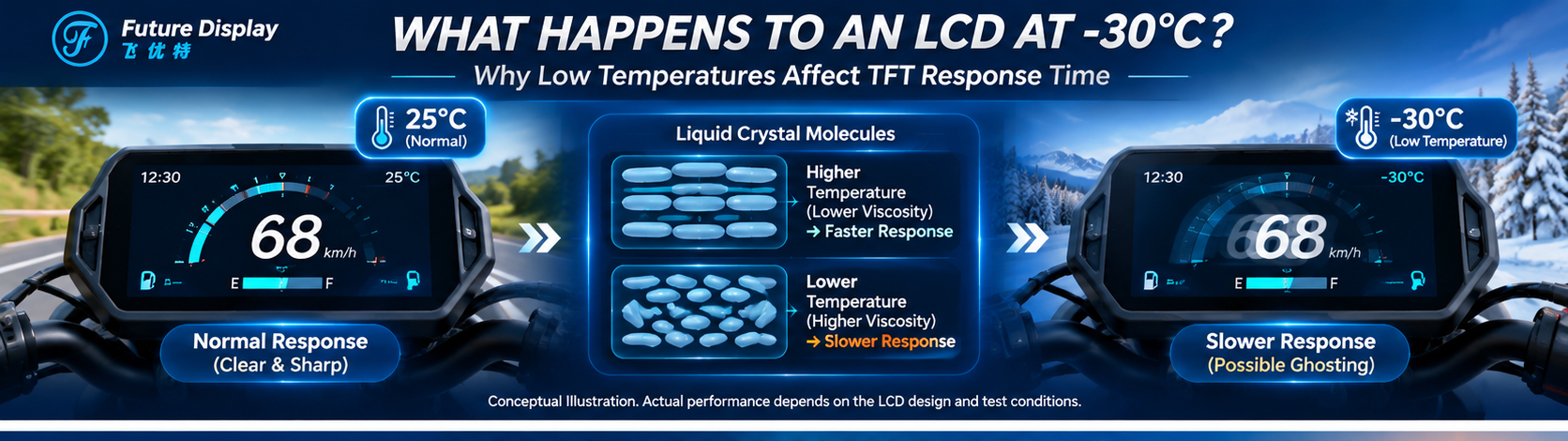
Future Display 7-inch wide-temperature motorcycle TFT LCD for outdoor instrument clusters, with an operating temperature range of -30°C to +85°C.
A TFT LCD does not create an image in the same way as a self-emissive display.
Its liquid crystal molecules change orientation under an electric field, controlling how light passes through the panel.
At lower temperatures, the rotational viscosity of the liquid crystal material generally increases.
This means the molecules can take longer to respond when the driving voltage changes.
As a result, the transition between one image and another may become slower.
Possible symptoms include:
- Slow Response: The pixels take longer to change between optical states.
- Ghosting: Previous image content appears to linger during transitions.
- Motion Smearing: Moving numbers or graphics appear less sharp.
- Contrast Changes: The displayed image may look different from its appearance at room temperature.
These effects depend on the liquid crystal formulation, panel structure, drive design and actual temperature.
Important: Not every wide-temperature TFT LCD exhibits the same degree of slowdown.
02 | Operating Temperature vs. Storage Temperature
These two specifications describe different environmental requirements.
| Specification | Operating Temperature | Storage Temperature |
|---|---|---|
| Definition | Powered operation | Non-operating exposure |
| Main Concern | Display functionality | Survival without unacceptable damage |
| Screen Powered On? | Yes | Normally no |
| Response Time | Must be checked against specified conditions | Not a powered-operation rating |
For example, a module may have an operating range of -30°C to +85°C and a storage range of -40°C to +90°C.
This does not mean it can be powered on at -40°C, nor does it guarantee room-temperature response speed at -30°C.
Always check the approved product datasheet and any additional low-temperature performance requirements.
03 | Refresh Rate and Response Time Are Not the Same
This is one of the most important distinctions for engineers designing digital instrument clusters.
Refresh Rate: Describes how frequently the display system updates or receives image frames, commonly expressed in hertz (Hz).
Response Time: Describes how long an LCD pixel takes to change between specified optical states, usually measured in milliseconds.
A display system may continue operating with a 60 Hz frame signal while the liquid crystal pixels respond more slowly because of low temperature.
The result can be visible motion blur or ghosting even though the electrical image update continues.
For motorcycle clusters displaying changing speeds, warning symbols and animations, the difference matters.
Ask the supplier: Is the low-temperature response time specified, or is only the operating temperature range confirmed?
04 | Can a TFT LCD Start Immediately at -30°C?
Cold-start capability should be treated as a specific design and validation requirement.
Some applications only require the display to power on and produce a readable image.
Others require the speedometer, navigation information or warning indicators to become visible within a defined time.
Therefore, customers should distinguish between:
- Electrical startup and initialization
- Backlight startup
- Initial image visibility
- Stable display operation
- Optical response during dynamic content changes
If immediate readability at -30°C is critical, the required startup behavior and acceptance criteria should be agreed upon during engineering evaluation.
A temperature rating alone is not enough to establish a specific cold-start time.
05 | What Happens at High Temperatures?
Wide-temperature operation is not only about cold weather.
Motorcycle dashboards, outdoor controllers and industrial instruments may also experience high temperatures.
Sunlight exposure, enclosed electronics and LED backlight operation can increase the temperature inside the equipment.
High temperatures may affect LCD contrast, backlight performance and the long-term reliability of optical materials and electronic components.
The internal module temperature may be higher than the surrounding air temperature, depending on the enclosure and thermal design.
For this reason, the finished equipment should be evaluated under representative operating conditions rather than relying only on ambient temperature.
06 | A Future Display 7-Inch Motorcycle TFT Example
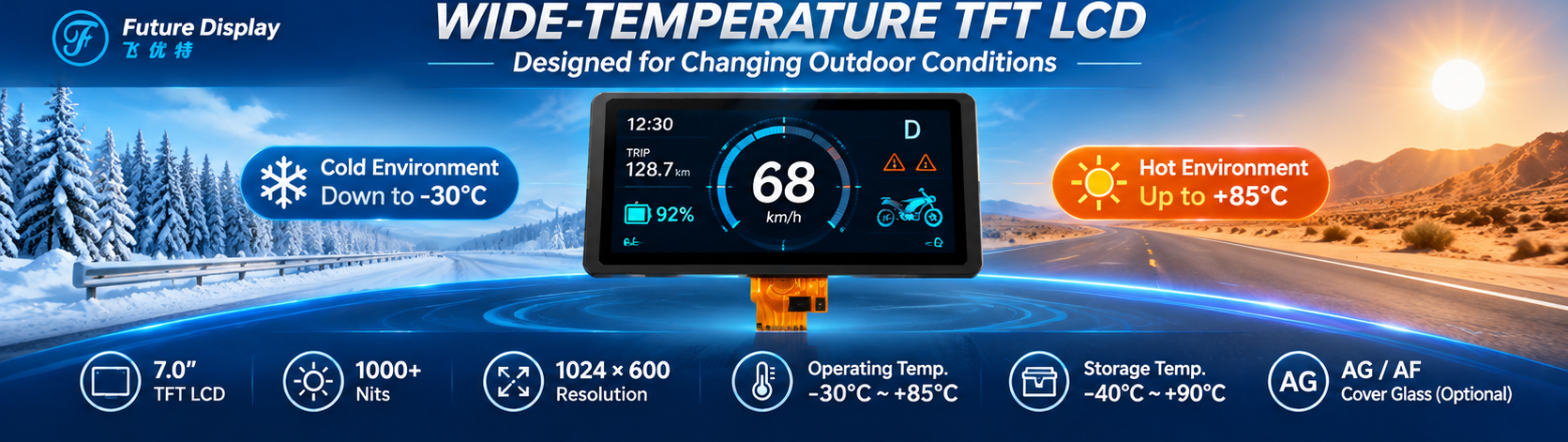
Future Display 7-inch wide-temperature motorcycle TFT LCD for outdoor instrument clusters, with an operating temperature range of -30°C to +85°C.
Future Display provides TFT LCD modules for two-wheeler instrument clusters and other embedded applications.
One relevant example is the 7-inch motorcycle TFT LCD, model FUT0700SV127Q-ZC-A0.
FUT0700SV127Q-ZC-A0
Display Size: 7.0 inches
Resolution: 1024 x 600
Brightness: 1000 cd/m² typical, according to the published product announcement
Display Interface: RGB 24-bit
Operating Temperature: -30°C to +85°C, based on the supplied model specifications
Storage Temperature: -40°C to +90°C, based on the supplied model specifications
Cover Glass Options: AG anti-glare and AF anti-fingerprint
Applications: Motorcycle dashboards, electric scooters and three-wheeler instrument clusters
The temperature ratings are based on supplied product information and should be checked against the latest approved datasheet. No specific response time at -30°C is claimed here.
This module illustrates how a high-brightness TFT display can be selected for vehicle projects that also require wide-temperature operation.
However, a -30°C operating rating should not be interpreted as a guarantee of a specific cold-start time or room-temperature optical response speed.
For projects requiring strict low-temperature image performance, Future Display can review the customer’s requirements and applicable engineering evaluation options.
Read about the Future Display 7-inch motorcycle TFT LCD.
07 | What Tests Matter for a Wide-Temperature LCD?
Different tests answer different engineering questions.
| Test | Purpose |
|---|---|
| Low-Temperature Operation | Evaluate display operation at specified cold conditions. |
| Cold-Start Evaluation | Check startup behavior from a cold-soaked state. |
| Response-Time Measurement | Measure optical transitions at required temperatures. |
| High-Temperature Operation | Evaluate operation under specified hot conditions. |
| Thermal Cycling | Examine the effects of repeated temperature changes. |
| Temperature and Humidity | Evaluate applicable moisture and environmental stresses. |
Testing conditions, durations, sample quantities and acceptance criteria should be defined for the selected project.
Important: A successful temperature storage test does not automatically demonstrate acceptable image response during powered low-temperature operation.
08 | Frequently Asked Questions
Can a TFT LCD work at -30°C?
Yes, some wide-temperature TFT LCD models are specified for operation down to -30°C. The actual operating range and low-temperature performance should be confirmed for the selected module.
Will an LCD show ghosting in cold weather?
It may. Lower temperatures generally increase liquid crystal response time, which can lead to ghosting or motion smearing. The severity depends on the display design and temperature.
Does a 60 Hz refresh rate prevent ghosting at -30°C?
No. Refresh rate and liquid crystal response time are different specifications. A display may continue receiving frames while its optical transitions become slower.
Does -40°C storage mean the LCD can run at -40°C?
No. Storage temperature applies to non-operating conditions. Powered operation must remain within the specified operating range unless additional engineering approval is provided.
Can an LCD start immediately at -30°C?
Cold-start behavior depends on the specific display module and host system. If immediate image visibility or a maximum startup time is required, it must be defined and tested.
Can Future Display customize a wide-temperature TFT LCD?
Future Display can review suitable wide-temperature TFT platforms, interface requirements, FPC configurations, cover glass and application-specific testing needs. Feasibility and performance depend on the selected module and approved design.
09 | Test Your Knowledge: Wide-Temperature LCD
Are you selecting a display for cold-weather equipment? Try these four questions before checking the answers.
Question 1: Why can LCD response time increase at -30°C?
A. Screen resolution automatically decreases
B. Liquid crystal rotational viscosity generally increases
C. The FPC becomes shorter
Show Answer 1
Correct Answer: B. Increased liquid crystal viscosity can slow the optical response of LCD pixels at low temperatures.
Question 2: A display is rated for -40°C storage. What does that mean?
A. It is guaranteed to operate at -40°C
B. It can be evaluated for specified non-operating exposure
C. Its response time remains unchanged at -40°C
Show Answer 2
Correct Answer: B. Storage ratings do not guarantee powered operation or optical response at that temperature.
Question 3: Can a 60 Hz display still show ghosting in cold weather?
A. Yes, because optical response time is different from frame refresh rate
B. No, 60 Hz guarantees perfect motion clarity
C. Only if the display has a touch panel
Show Answer 3
Correct Answer: A. The image signal can continue updating while LCD pixel transitions slow down.
Question 4: Which information is most useful for a wide-temperature TFT RFQ?
A. Only the screen diagonal
B. Only the target unit price
C. Operating temperatures, cold-start requirements, interface, drawings and annual quantity
Show Answer 4
Correct Answer: C. A detailed RFQ helps the supplier review both the display platform and application-specific validation requirements.
Ready for your own project? Use the checklist below to prepare an RFQ for engineering review.
10 | RFQ: Request a Wide-Temperature TFT LCD Quote
Developing a motorcycle dashboard, outdoor instrument or industrial control panel for demanding temperature conditions?
Send Future Display your requirements using the following checklist.
Wide-Temperature TFT LCD RFQ Checklist
1. Application: Motorcycle / Industrial HMI / Outdoor Instrument / Other
2. Display Size and Resolution: Required specifications
3. Operating Temperature: Minimum and maximum temperatures
4. Storage Temperature: Required non-operating limits
5. Cold-Start Requirement: Minimum startup temperature and maximum acceptable startup time
6. Response-Time Requirement: Required optical response or acceptable image behavior at low temperature
7. Display Content: Static readings / Dynamic numbers / Animation / Video
8. Brightness and Cover Glass: Required luminance, surface treatments and bonding
9. Display Interface: RGB / MIPI / LVDS / Other
10. FPC and Mechanical Design: Dimensions, connector and drawings
11. Reliability Requirements: Applicable tests, durations and acceptance criteria
12. Purchasing Information: Sample quantity, estimated annual demand and project timeline
Attachments: LCD datasheet, CAD drawing, operating-environment details or reference photos
Send Your RFQ to Future Display
Email: info@futurelcd.com
Contact Page: Contact Future Display
Share your requirements so our team can evaluate suitable display options and technical feasibility.
11 | Why Work with Future Display?
Hunan Future Electronics Technology Co., Ltd. provides LCD and TFT display module solutions for industrial equipment, motorcycles, smart home products and other embedded systems.
Our manufacturing capabilities cover TFT LCD modules, monochrome LCDs and associated display integration solutions.
For wide-temperature projects, our team can review suitable display models, FPC and interface requirements, mechanical integration and applicable environmental validation needs.
With LCD manufacturing experience since 2005, Future Display supports customers from display selection and sample evaluation through production planning.
Discuss your project with our team through the Future Display inquiry page.
Conclusion: Wide Temperature Means More Than Surviving the Cold
A TFT LCD operating temperature range is an essential specification, but it is only part of the engineering decision.
At -30°C, liquid crystal response may slow down even when the display remains powered and functional.
For motorcycle instrument clusters and industrial systems, engineers should confirm cold-start behavior, dynamic image response, temperature ratings and the requirements of the complete equipment.
A well-selected wide-temperature LCD is one that meets the operating needs of the final product, not simply one with an impressive temperature range on the datasheet.
Future Display | Custom TFT LCD and Industrial Display Solutions
Post time: Nov-04-2026


