
A Wide Viewing Angle Looks Great on Paper. But What Does the Rider Actually See?
Imagine an engineering team selecting a TFT LCD for a new motorcycle instrument cluster.
On the test bench, the display looks excellent. The colors are vivid, the speed indicators are sharp, and the datasheet lists a wide viewing angle.
However, after the module is installed in the dashboard, something changes.
From the rider’s natural seating position, dark backgrounds appear slightly lighter. Certain colors look different, and some small warning symbols seem less distinct.
The screen is still functioning. So why does it look different?
Q | REAL CUSTOMER QUESTION
“Our motorcycle LCD has a wide viewing angle. Why do the colors and contrast still change when the rider looks at it from above?”
The answer involves liquid crystal optics, viewing direction, polarization, and a less visible but important display component: the Optical Compensation Film.
For engineers and purchasing teams, understanding these factors can help prevent display-selection problems before a new instrument cluster enters production.
01 | Why Does the Rider’s Viewing Position Matter?
Unlike a laptop or desktop monitor, a motorcycle dashboard is installed at a fixed position and angle inside the vehicle.
The rider does not necessarily look straight at the center of the LCD.
Depending on vehicle geometry and seating posture, the normal viewing position may be above the display, slightly to one side, or at a combination of vertical and horizontal angles.
Rider height, riding posture, handlebar geometry, and dashboard installation can all influence the viewing experience.
SCENARIO 01 | LABORATORY TEST VS. REAL MOTORCYCLE INSTALLATION
A 7-inch TFT LCD looks clear when viewed directly from the front. After installation in a tilted motorcycle dashboard, the rider notices reduced contrast when looking down at the screen. Should the engineering team immediately replace the LCD?
Not necessarily.
The first step should be to identify the actual observation angle and compare the display’s optical performance at that position.
Four factors should be evaluated together:
01 | VIEWING DIRECTION
Determine where the rider’s eyes are located relative to the display, including vertical and horizontal angles.
02 | CONTRAST PERFORMANCE
Check whether dark and bright information remains distinguishable at the intended viewing angles.
03 | COLOR STABILITY
Evaluate whether warning indicators, icons, and other interface colors change significantly when viewed off-axis.
04 | AMBIENT REFLECTIONS
Consider sunlight and reflections from the front cover glass, which can further affect perceived readability.
Engineering Insight: A wide viewing angle is useful only when the display maintains acceptable visibility and image quality in the positions where the rider actually uses it.
02 | Why Can an LCD Change Color When Viewed from an Angle?
To understand viewing-angle performance, we first need to understand how an LCD controls light.
A typical transmissive TFT LCD uses a backlight, polarizers, and a liquid crystal layer to produce an image.
The liquid crystal material is optically anisotropic. This means its interaction with light depends on the polarization and propagation direction of that light.
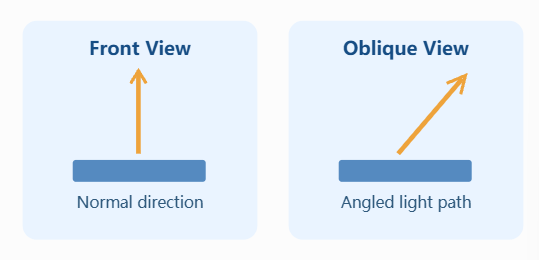
When the viewing direction changes, the optical path and effective birefringence can also change.
These changes may affect the polarization state of light passing through the LCD’s optical system.
The result can include several visible effects:
COLOR SHIFT
A color may change in hue, saturation, or other aspects of appearance when viewed from an oblique direction.
CONTRAST REDUCTION
The difference between bright and dark image areas may become smaller at certain angles.
OFF-AXIS LIGHT LEAKAGE
Dark areas may appear brighter because unwanted light passes through the optical system at particular viewing angles.
GRAY-LEVEL VARIATION
Gray tones may change in appearance or become more difficult to distinguish from particular directions.
These effects depend on the LCD mode, polarizer arrangement, optical films, driving conditions, and display construction.
They are not necessarily signs of a defective module. However, they can become design problems when the display is not suitable for its intended viewing geometry.
03 | What Is an Optical Compensation Film?
An Optical Compensation Film is a specially designed optical film used to manage polarization and phase changes in an LCD system.
It may also be called a Retardation Film or Phase Compensation Film.
The principle involves birefringence, which means different polarization components can experience different refractive indices in a material.
When light passes through a birefringent layer, a phase difference may develop between its polarization components.
This is called optical retardation.
A compensation film introduces a designed optical retardation to help counteract selected unwanted effects caused by the liquid crystal layer and polarization system at different viewing directions.
OPTICAL COMPENSATION | SIMPLIFIED PRINCIPLE
Liquid Crystal Optical Effect → Angle-Dependent Polarization Change → Designed Film Compensation → Improved Off-Axis Optical Performance
Conceptual explanation. The actual optical sequence and film structure depend on the LCD design.
Engineers may evaluate properties such as:
- Birefringence: The difference between relevant refractive indices.
- Retardation: The phase difference introduced by an optical layer.
- Optical Axis Orientation: The direction of the material’s optical properties.
- Wavelength Dependence: How compensation behavior changes across different colors of light.
- Viewing-Angle Dependence: How the optical correction performs for different light directions.
Because these properties must be matched to the liquid crystal and polarizer structure, compensation films are not universal accessories.
Important: Adding an arbitrary optical film to the front of an existing module does not guarantee an improvement in its viewing-angle performance.
04 | Can Optical Compensation Eliminate Color Shift Completely?
No. Optical compensation is an optimization technique, not a guarantee that an LCD will look identical at every angle.
Different viewing directions can produce different polarization and color effects. A compensation design may improve one group of optical characteristics without eliminating every variation.
For example, engineers may prioritize reduced dark-state light leakage, improved off-axis contrast, or better color stability within a specific viewing range.
SCENARIO 02 | DARK DASHBOARD THEMES AND WARNING ICONS
A motorcycle dashboard uses a black background with blue, red, and white indicators. The interface looks balanced from the front, but the dark background becomes lighter at an oblique angle. Can optical compensation help?
Depending on the LCD technology and optical design, suitable compensation may help reduce certain off-axis light-leakage effects.
However, the engineering team should evaluate the complete display, including contrast, color shift, polarizers, and the required viewing directions.
ENGINEERING INSIGHT
The goal is not to eliminate every optical change at every angle. It is to achieve acceptable performance in the viewing range required by the final product.
05 | IPS vs. VA vs. TN: Do They Need the Same Optical Compensation?
IPS, VA, and TN are different liquid crystal operating modes.
They have different optical characteristics, so their compensation requirements can also differ.
| LCD Mode | Viewing-Angle Consideration | Design Focus |
|---|---|---|
| TN | Certain directions may show stronger contrast or gray-level changes. | Improve selected directional viewing characteristics. |
| VA | Off-axis dark-state contrast and color can change. | Manage light leakage and angle-dependent optical performance. |
| IPS | Generally offers wide viewing angles, but is not completely free of optical variation. | Refine off-axis contrast and color performance where required. |
A common misunderstanding is that IPS technology automatically eliminates the need for optical compensation.
IPS generally offers favorable wide-angle viewing characteristics, but this does not mean all IPS TFT LCDs have identical optical behavior.
Panel structure, polarizers, compensation design, and the target viewing geometry can still affect the final result.
Key distinction: IPS describes a liquid crystal operating mode. An optical compensation film is part of an optical design approach used to manage specific polarization effects.
06 | Does a 178-Degree Viewing Angle Guarantee Consistent Colors?
SCENARIO 03 | TWO SUPPLIERS, THE SAME VIEWING-ANGLE RATING
Two TFT LCD suppliers advertise a wide viewing angle. Both modules appear suitable on paper, but one shows more visible color change from the motorcycle rider’s normal viewing position. How should the customer compare them?
The answer is to examine the measurement criteria behind the published viewing-angle number.
Some LCD datasheets define viewing angle using a minimum contrast-ratio threshold, such as 10:1.
However, meeting a contrast-ratio threshold does not mean the image maintains identical colors, brightness, or black-level appearance across the entire specified range.
For a more useful comparison, engineers may review:
- Viewing Angle: Defined up, down, left, and right limits.
- Contrast Ratio: Minimum contrast under specified viewing conditions.
- Color Shift: Changes in chromaticity or color appearance at selected angles.
- Luminance Variation: Changes in brightness with viewing direction.
- Dark-State Performance: Light leakage and black-level stability.
PROCUREMENT TIP
When comparing display suppliers, ask for the viewing-angle measurement definition and any available optical data at the actual installation angles. Do not treat a single wide-angle number as a complete image-quality specification.
07 | Optical Compensation vs. AG, AR, AF, and OCA: What Is the Difference?
Several optical technologies can affect the readability and appearance of a motorcycle TFT LCD.
However, they solve different problems.
| Technology | Main Function | Main Concern |
|---|---|---|
| Optical Compensation Film | Manages angle-dependent polarization effects. | Viewing angle, contrast, color shift. |
| AG Anti-Glare | Scatters reflected light. | Glare, haze, clarity. |
| AR Anti-Reflection | Reduces surface reflectance. | Reflections, wavelength, angle. |
| AF Anti-Fingerprint | Improves resistance to fingerprints and smudging. | Cleanability, surface durability. |
| OCA Optical Bonding | Replaces selected internal air gaps with optical adhesive. | Internal reflections, bonding reliability. |
For example, if the LCD changes color when viewed from above, replacing the front glass with AG glass will not automatically correct the liquid crystal optical behavior.
Similarly, an optical compensation film is not a direct replacement for AR coating when the primary problem is reflection from the glass surface.
Good display engineering starts by identifying the actual cause of the viewing problem.
08 | Future Display: A 7-Inch Motorcycle TFT LCD Example
Future Display provides customized TFT LCD modules for motorcycle instrument clusters, industrial equipment, and embedded display applications.
One example is FUT0700SV127Q-ZC-A0, a 7-inch high-brightness TFT LCD platform for two-wheeler dashboards.
FUT0700SV127Q-ZC-A0 | Product Overview
Display Size: 7.0 inches
Resolution: 1024 x 600
Display Type: IPS TFT LCD
Brightness: 1000+ nits
Interface: RGB 24-bit
Operating Temperature: -30 to +85 degrees Celsius
Application: Motorcycle and two-wheeler instrument clusters
Specific viewing-angle measurement results and the internal optical compensation-film construction should be confirmed from the latest approved technical documentation.
This product offers an example of how brightness, viewing-angle performance, and temperature requirements come together in a motorcycle display project.
However, its published specifications do not independently verify a particular optical compensation-film design or a numerical off-axis color-shift rating.
For suitable projects, Future Display can review the target viewing directions, LCD technology, optical requirements, cover-glass structure, and integration needs.
Explore Future Display’s 7-Inch Motorcycle TFT LCD
09 | Frequently Asked Questions
Q1. Why does an LCD change color when viewed from the side?
Its polarization and optical transmission characteristics can vary with viewing direction. Depending on the LCD structure, this may cause changes in color, brightness, and contrast.
Q2. What does an optical compensation film do?
It helps compensate for selected angle-dependent phase and polarization changes, improving specific aspects of the LCD’s off-axis optical performance.
Q3. Can an optical compensation film completely eliminate color shift?
No. Its performance depends on the liquid crystal mode, film structure, wavelength, and viewing direction. It is an optical optimization method rather than a universal correction.
Q4. Do all IPS TFT LCDs use the same compensation film?
No. IPS modules may use different optical designs. The exact compensation-film configuration varies by panel construction and supplier.
Q5. Does a 178-degree viewing-angle rating mean the image looks identical at every angle?
No. Viewing-angle ratings are typically based on defined measurement criteria and do not guarantee constant brightness, contrast, or color across the entire range.
Q6. Can AG or AR cover glass solve internal LCD color shift?
Not directly. AG and AR primarily manage reflections, while internal LCD viewing-angle behavior depends on the liquid crystal and optical polarization system.
Q7. What viewing-angle information should a motorcycle manufacturer provide?
The display mounting angle, expected rider eye positions, preferred viewing directions, required contrast, color-shift limits, and any applicable optical acceptance criteria.
Q8. Can Future Display support customized viewing-angle requirements?
Future Display can review optical and mechanical requirements for suitable TFT LCD platforms. Available configurations and performance targets depend on engineering feasibility.
10 | Quick Knowledge Check: Motorcycle LCD Viewing Angles
Choose an answer before opening the explanation.
Question 1: What is the main purpose of an optical compensation film?
A. Increase LED backlight power.
B. Improve selected angle-dependent LCD optical characteristics.
Show Answer
Answer: B. Optical compensation films manage polarization and phase effects rather than directly increasing the backlight output.
Question 2: Does IPS completely eliminate viewing-angle color shift?
A. Yes, every IPS display looks identical from every direction.
B. No, color and contrast may still vary with viewing direction.
Show Answer
Answer: B. IPS generally provides wide viewing angles, but actual optical performance depends on the complete panel design.
Question 3: What should a motorcycle manufacturer check before selecting a display?
A. The actual rider viewing position and mounting angle.
B. Only the maximum advertised viewing-angle number.
Show Answer
Answer: A. Viewing-angle performance should be evaluated under the conditions in which the display will actually be used.
Question 4: Which technology primarily reduces reflections from the front glass?
A. AR coating.
B. Optical compensation film.
Show Answer
Answer: A. AR coating is designed to reduce surface reflectance. Optical compensation film addresses selected internal polarization effects.
11 | RFQ: Request a TFT LCD with Suitable Viewing-Angle Performance
Are you developing a motorcycle dashboard, industrial HMI, or embedded display that must remain readable from different viewing directions?
Clear optical requirements help the engineering team select a suitable display configuration and avoid unnecessary design changes later.
Motorcycle TFT LCD | Viewing-Angle RFQ Checklist
- Application: Motorcycle / Industrial HMI / Instruments / Other.
- Display Size: Required diagonal and resolution.
- Installation Angle: Expected mounting position and enclosure drawings.
- Primary Viewing Direction: Above / Below / Left / Right / Multiple Directions.
- Rider Eye Position: Expected observation points relative to the display.
- Contrast Requirement: Minimum acceptable contrast at defined viewing angles.
- Color Shift: Permitted color or chromaticity variation.
- Brightness: Required luminance and lighting conditions.
- Cover Glass: AG / AR / AF if applicable.
- Optical Bonding: Required display assembly structure.
- Operating Environment: Temperature, sunlight exposure, and installation conditions.
- Reference Files: Existing LCD datasheet, mechanical drawings, or reference photos.
- Purchasing Plan: Prototype quantity, annual demand, and project timeline.
Request Engineering Review & Quotation
Email: info@futurelcd.com
Online Inquiry: Contact Future Display
Tell us where and how your display will be viewed, and our team can review suitable optical and integration requirements.
12 | Continue Learning: Other Technologies Behind Motorcycle LCD Performance
Viewing-angle performance is only one part of an effective motorcycle display.
The following related technologies address other engineering challenges, from sunlight readability to long-term environmental reliability.
01 | SUNLIGHT-READABLE TFT LCDS
A high-brightness LCD can improve outdoor visibility, but reflections and display contrast are also important. Learn why the highest nit value alone is not enough.
02 | OCA OPTICAL BONDING VS. AIR GAP
Discover how replacing selected internal air gaps with optical adhesive can reduce unwanted reflections and improve the optical integration of a display.
03 | WIDE-TEMPERATURE TFT LCDS
Explore why low-temperature operation, liquid crystal response, and the surrounding equipment environment matter for motorcycle and industrial LCD performance.
04 | UV RESISTANCE AND OUTDOOR WEATHERING
Learn why long-term sunlight exposure may affect selected display materials, including optical adhesives, polarizers, and other components.
Conclusion | A Wide Viewing Angle Is More Than a Number
Optical compensation films are an important part of LCD optical engineering. They can help improve selected viewing-angle characteristics by managing polarization and phase changes within the display system.
However, a successful motorcycle instrument cluster requires more than a wide viewing-angle specification.
Engineers should also evaluate rider eye position, installation geometry, contrast, color stability, ambient reflections, and the complete display structure.
The best viewing-angle performance is not simply the largest number in a datasheet. It is the visibility, contrast, and color quality that work in the final motorcycle dashboard.
Future Display provides customized TFT LCD and display-module solutions for motorcycle instrument clusters, industrial equipment, and embedded applications.
Post time: Nov-25-2026


