
AG vs. AR vs. AF: Which Cover Glass Treatment Is Best for Motorcycle TFT LCDs?
One Motorcycle Display. Three Surface Treatments. Which One Really Matters?
For motorcycle TFT LCD displays, visibility and durability are essential considerations.
Imagine riding a motorcycle on a sunny afternoon. The digital dashboard is bright, but reflections from the sky make important information difficult to read.
Later, fingerprints and road dust collect on the cover glass. After repeated cleaning, another question arises: will the surface treatment continue to perform?
Three common technologies help address these challenges: AG (Anti-Glare), AR (Anti-Reflection), and AF (Anti-Fingerprint).
Q | REAL CUSTOMER QUESTION
“Should we choose AG, AR, or AF glass for our motorcycle display? Can these treatments be combined?”
These technologies are often mentioned together, but they solve different problems.
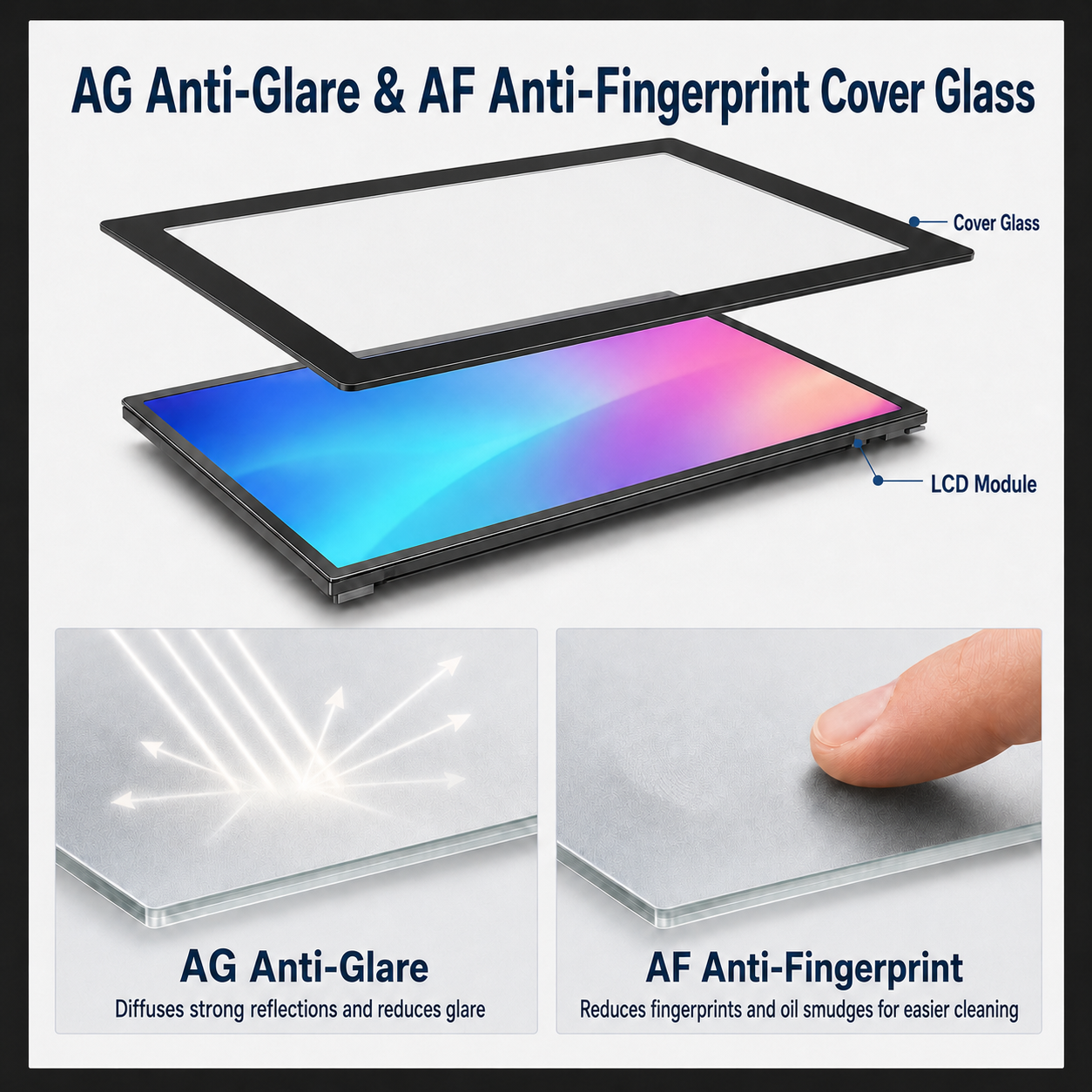
AG scatters reflected light. AR reduces surface reflectance. AF helps reduce fingerprint smudging and makes the glass easier to clean.
The best choice depends on the display application, viewing conditions, optical requirements, surface durability, and project budget.
01 | Three Technologies, Three Different Functions
Before selecting a cover-glass treatment, it is important to understand what each technology is designed to do.
01 | AG – ANTI-GLARE
Main Function: Reduce distracting mirror-like reflections.
Principle: Surface microstructures or suitable coatings scatter reflected light.
Key Concern: Haze, image clarity, and sparkle.
02 | AR – ANTI-REFLECTION
Main Function: Reduce surface reflectance.
Principle: Optical coating technology, commonly based on thin-film interference.
Key Concern: Reflectance, wavelength, viewing angle, and coating cost.
03 | AF – ANTI-FINGERPRINT
Main Function: Reduce fingerprint smudging and improve cleaning.
Principle: Low-surface-energy coating helps reduce oil spreading or adhesion.
Key Concern: Oleophobic performance, abrasion resistance, and cleaning compatibility.
These treatments are not competing performance grades. They address different aspects of the cover-glass experience.
02 | AG Glass: Reducing Glare Without Sacrificing Clarity
AG stands for Anti-Glare.
Anti-glare glass uses surface microstructures or specialized coatings to scatter reflected light, reducing the intensity of mirror-like reflections.
For motorcycle dashboards, this can help make reflections from the sky and surrounding environment less distracting.
SCENARIO 01 | THE DASHBOARD LOOKS BETTER OUTDOORS BUT LESS SHARP INDOORS
A manufacturer selects a stronger AG treatment. Sharp reflections become less distracting, but small text and warning icons appear slightly less crisp. Why does this happen?
AG treatments scatter light. However, stronger scattering may also affect perceived image clarity.
Engineers should consider several optical parameters:
HAZE
Describes light scattering. Excessive haze may affect perceived image sharpness.
GLOSS
Describes the appearance of surface reflections and surface gloss.
CLARITY
Indicates how clearly fine details remain visible through the glass.
SPARKLE
Refers to grainy visual artifacts that may appear when an AG surface interacts with display pixels.
Q | WILL AG GLASS MAKE THE DISPLAY BLURRY?
Some AG treatments may affect image clarity, particularly when haze is high. The right solution balances reflection control with the visibility of text, graphics, and warning indicators.
Engineering Insight: Stronger AG treatment does not automatically mean better display performance. Sample evaluation should include both outdoor glare and indoor image clarity.
03 | AR Coating: Reducing Reflections Through Optical Design
AR stands for Anti-Reflection.
Unlike AG, which scatters reflected light, AR coatings are designed to reduce the amount of reflected light.
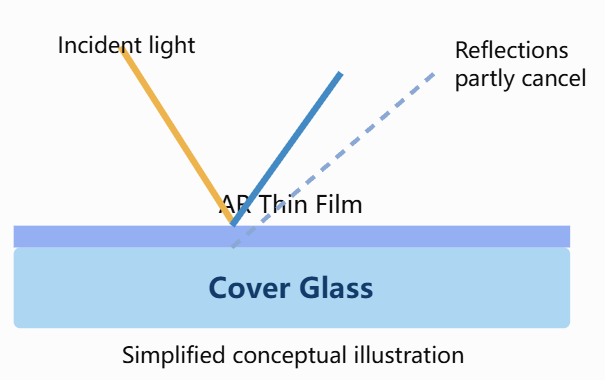
AR technology commonly uses thin-film optical interference. By carefully selecting coating materials and thicknesses, reflections from different optical interfaces can partially cancel one another.
This helps reduce surface reflectance while maintaining image clarity.
SIMPLIFIED AR PRINCIPLE
Incident Light → AR Coating → Reduced Reflected Light
Conceptual illustration. Actual performance depends on coating design, wavelength, and angle of incidence.
Engineers should review:
- Reflectance: The proportion of incident light reflected under defined conditions.
- Wavelength Range: The spectrum over which the coating is designed to reduce reflections.
- Viewing Angle: The effect of incident angle on coating performance.
- Coating Structure: Materials and layer design.
- Durability: Resistance to applicable environmental and cleaning conditions.
Q | IS AR ALWAYS BETTER THAN AG FOR OUTDOOR DISPLAYS?
Not necessarily. AR may be attractive when lower reflectance and image clarity are priorities, while AG can be useful when reducing distinct mirror-like reflections is the main objective.
The best choice depends on the intended lighting environment, optical requirements, coating durability, and budget.
Important: AR does not increase LED backlight output. It changes the way light interacts with the cover-glass surfaces.
04 | AF Coating: Keeping Touchscreens Cleaner
AF stands for Anti-Fingerprint.
AF coatings commonly use low-surface-energy materials to reduce the spreading or adhesion of fingerprint oils and make cleaning easier.
For frequently touched motorcycle dashboards, this treatment may improve the maintenance experience.
However, AF does not make a screen completely fingerprint-proof.
SCENARIO 02 | GLOVES, DUST, AND FREQUENT CLEANING
A motorcycle rider regularly operates the touchscreen while wearing gloves. The display is also exposed to road dust and repeated wiping. Will this damage the AF treatment?
Repeated glove contact does not automatically damage the coating.
However, coating performance may change depending on glove material, contact pressure, abrasive particles, cleaning agents, and coating durability.
Engineers should evaluate:
- Oleophobic Performance: Resistance to oil spreading and smudging.
- Contact Angle: Surface wettability under a defined test method.
- Abrasion Resistance: Performance after repeated friction.
- Chemical Compatibility: Resistance to the intended cleaning materials.
- Visual Appearance: Surface marks, wear, or changes after use.
ENGINEERING INSIGHT | AF DURABILITY VS. GLOVE TOUCH
AF Durability: Describes how well the surface treatment maintains its properties after use.
Glove Touch: Describes whether the touch sensor and controller can detect input through a glove.
These are separate engineering requirements and should be evaluated independently.
05 | AG vs. AR vs. AF: Key Differences
The following comparison highlights the primary functions and technical considerations of each cover-glass treatment.
| Feature | AG | AR | AF |
|---|---|---|---|
| Full Name | Anti-Glare | Anti-Reflection | Anti-Fingerprint |
| Main Purpose | Reduce visible glare | Reduce reflectance | Reduce smudging |
| Principle | Light scattering | Optical interference | Low surface energy |
| Key Parameters | Haze, clarity, sparkle | Reflectance, wavelength, angle | Oleophobicity, abrasion |
| Main Concern | Image clarity | Performance and cost | Surface durability |
| Typical Use | Bright environments | Low-reflection displays | Frequently touched displays |
Key Takeaway: AG, AR, and AF are complementary technologies. The right selection depends on the problem the customer needs to solve.
06 | Can AG, AR, and AF Be Combined?
Yes. Compatible AG, AR, and AF treatments may be combined on selected cover-glass structures.
For a motorcycle dashboard exposed to sunlight and frequent cleaning, engineers may evaluate different combinations.
AG + AF | GLARE CONTROL AND CLEANABILITY
May be considered for outdoor displays where mirror-like reflections and surface smudging are both concerns.
AR + AF | LOW REFLECTANCE AND CLEANABILITY
May be evaluated for applications that prioritize reduced reflectance, image clarity, and easier cleaning.
AG + AR + AF | COMBINED OPTICAL AND SURFACE FUNCTIONS
May be considered when all three functions are required, subject to coating compatibility, durability, and manufacturing feasibility.
However, more coatings do not automatically mean better overall performance.
The final design should consider:
- Optical performance and image clarity.
- Coating compatibility and manufacturing feasibility.
- Abrasion resistance and cleaning requirements.
- Environmental durability.
- Manufacturing cost and project volume.
ENGINEERING INSIGHT
The best cover-glass structure is not necessarily the one with the most surface treatments. It is the one that provides the required optical and durability performance for the actual application.
07 | Future Display Motorcycle TFT LCD Solutions
Future Display provides customized TFT LCD modules for motorcycle instrument clusters and industrial applications.
One example is the FUT0700SV127Q-ZC-A0, a 7-inch motorcycle TFT LCD module for two-wheeler display applications.
FUT0700SV127Q-ZC-A0 | Product Overview
Display Size: 7.0 inches
Resolution: 1024 x 600
Brightness: 1000+ nits
Interface: RGB 24-bit
Operating Temperature: -30°C to +85°C
Application: Motorcycle and two-wheeler instrument clusters
Final specifications and available cover-glass configurations should be confirmed against the approved product documentation.
For suitable projects, Future Display can review AG and AF cover-glass requirements, including dimensions, surface treatment, touch integration, and optical bonding.
If AR coating is required, its feasibility and specific optical performance should be reviewed with the engineering team.
Explore Future Display’s 7-Inch Motorcycle TFT LCD
08 | Frequently Asked Questions
Q1. What is the main difference between AG and AR?
AG scatters reflected light to reduce distracting glare, while AR reduces surface reflectance through optical design.
Q2. Does AG glass reduce display sharpness?
Some AG treatments may increase haze or sparkle and affect perceived image clarity. The final result depends on the glass and display assembly.
Q3. Does AR coating increase LCD brightness?
AR does not increase LED backlight output. It reduces certain reflections and may improve the optical transmission and readability of the completed display.
Q4. Can AG, AR, and AF be applied together?
Yes. Compatible treatments may be combined, but their performance and manufacturing feasibility must be evaluated.
Q5. Does AF coating support glove touch?
No. Glove-touch capability depends mainly on the touch sensor, controller, and system configuration.
Q6. Will AF coating remain effective after repeated cleaning?
Performance depends on the coating material, abrasion conditions, cleaning agents, and durability requirements. Suitable testing should be agreed upon for the project.
Q7. Can Future Display provide customized cover-glass solutions?
Future Display can review cover-glass dimensions, AG and AF treatments, optical bonding, and other display integration requirements. Specific AR options require further engineering confirmation.
09 | How to Choose the Right Cover Glass
Before selecting a cover-glass treatment, manufacturers should identify the actual problem they want to solve.
Q | THREE QUESTIONS TO ASK BEFORE SELECTING AG, AR, OR AF
1. Are strong reflections making important display information difficult to read?
2. Is maintaining fine image detail and low surface reflectance the priority?
3. Will users frequently touch, wipe, or clean the cover glass?
These questions can help determine whether AG, AR, AF, or a combination should be evaluated.
Manufacturers should also define environmental and reliability requirements, including expected sunlight exposure, abrasion conditions, and cleaning procedures.
For customized display projects, customers should provide the application, display dimensions, optical performance targets, required surface treatment, and estimated purchase volume.
10 | RFQ: Request a Custom Cover Glass Solution
Are you developing a motorcycle dashboard, industrial control panel, or embedded touch display?
Share the following requirements so Future Display can review suitable cover-glass options.
AG / AR / AF Cover Glass | RFQ Checklist
- Application: Motorcycle / Industrial HMI / Medical / Smart Home.
- Display Size: LCD diagonal, resolution, and glass dimensions.
- Surface Treatment: AG / AR / AF / Combined / To Be Evaluated.
- AG Requirements: Haze, gloss, clarity, and sparkle.
- AR Requirements: Target reflectance, wavelength range, and angle.
- AF Requirements: Oleophobic performance and abrasion resistance.
- Touch Requirements: Capacitive touch and glove operation, if applicable.
- Cleaning Conditions: Cleaning agents and wiping frequency.
- Reliability: Abrasion, temperature, humidity, and environmental requirements.
- Bonding: Optical bonding / Air gap / To Be Evaluated.
- Purchasing: Sample quantity, estimated annual volume, and project timeline.
Discuss Your Display Project with Future Display
Email: info@futurelcd.com
Online Inquiry: Contact Future Display
Share your optical and surface durability requirements so our team can review a suitable cover-glass solution for your application.
11 | Continue Learning: Other Technologies Behind Motorcycle LCD Performance
Cover-glass surface treatment is only one part of a reliable motorcycle display.
The following technologies address additional engineering challenges, including sunlight readability, internal reflections, and long-term durability.
01 | HIGH-BRIGHTNESS TFT LCD BACKLIGHTS
Learn how LED current, power consumption, thermal design, and dimming affect the long-term performance of high-brightness TFT LCDs.
02 | OCA OPTICAL BONDING
Discover how reducing selected internal air gaps can help manage reflections and improve the optical integration of TFT LCD assemblies.
03 | LCD VIEWING ANGLES AND OPTICAL COMPENSATION
Understand why LCD colors and contrast can change when viewed from an angle and how optical compensation films help improve viewing performance.
04 | UV RESISTANCE AND OUTDOOR WEATHERING
Explore why long-term sunlight exposure may affect optical adhesives, polarizers, and other display materials.
Explore More Future Display Solutions
Conclusion | The Best Cover Glass Solves the Right Problem
AG, AR, and AF are three different technologies that can improve the user experience of TFT LCD displays.
AG reduces distracting reflections by scattering light. AR reduces surface reflectance through optical coating technology. AF helps reduce fingerprints and makes the glass easier to clean.
For motorcycle dashboards and industrial displays, the right selection depends on sunlight conditions, image clarity, touch requirements, durability, and cost.
The best cover glass is not necessarily the one with the most coatings, but the one that meets the actual requirements of the application.
Future Display | Customized TFT LCD and Touch Display Solutions
Post time: Nov-25-2026


