

VA LCD vs. TFT Display: Which Is Better for Smart Home Control Panels?
Does Every Smart Home Device Really Need a Full-Color Screen?
A smart thermostat needs to show temperature, fan speed and operating mode.
A smart home control hub may need colorful icons, multiple menus and touch interaction.
Both are smart devices. But do they really need the same display technology?
Not necessarily.
Sometimes, a custom VA LCD is the smarter choice. Other times, a color TFT is worth the investment.
The right decision depends on what your product needs to display, how users interact with it and how the device will be manufactured.
01 | VA LCD: Simple Information, Premium Appearance
VA (Vertical Alignment) segment LCDs are particularly suitable for products that display predefined numbers, symbols and status indicators.
Their dark-background appearance can create a clean, modern look when combined with an appropriate backlight.
Typical Applications
- Smart thermostats
- Air conditioning controllers
- Household appliances
- Smart switches and control panels
- Temperature and humidity displays
Why Choose VA LCD?
Custom-designed icons and digits, straightforward interfaces and potentially low display-driving power make VA segment LCDs attractive for products with stable display content.
However, a VA segment LCD cannot freely display new images or complex software-defined graphics like a TFT.
02 | TFT LCD: More Colors, More Interaction
What if your product needs animated icons, multiple pages, graphics or a touch-based interface?
That’s where a TFT LCD becomes more suitable.
TFT modules provide pixel-based color displays, allowing developers to design more flexible user interfaces.
Typical Applications
- Smart home control hubs
- Smart speakers
- Robot vacuum cleaners
- Advanced appliance interfaces
- Interactive home automation panels
Why Choose TFT LCD?
Full-color graphics, flexible UI layouts and optional touch integration make TFT displays suitable for products requiring richer interaction.
The trade-off is that the complete system may involve higher power consumption, more software development and additional electronics.
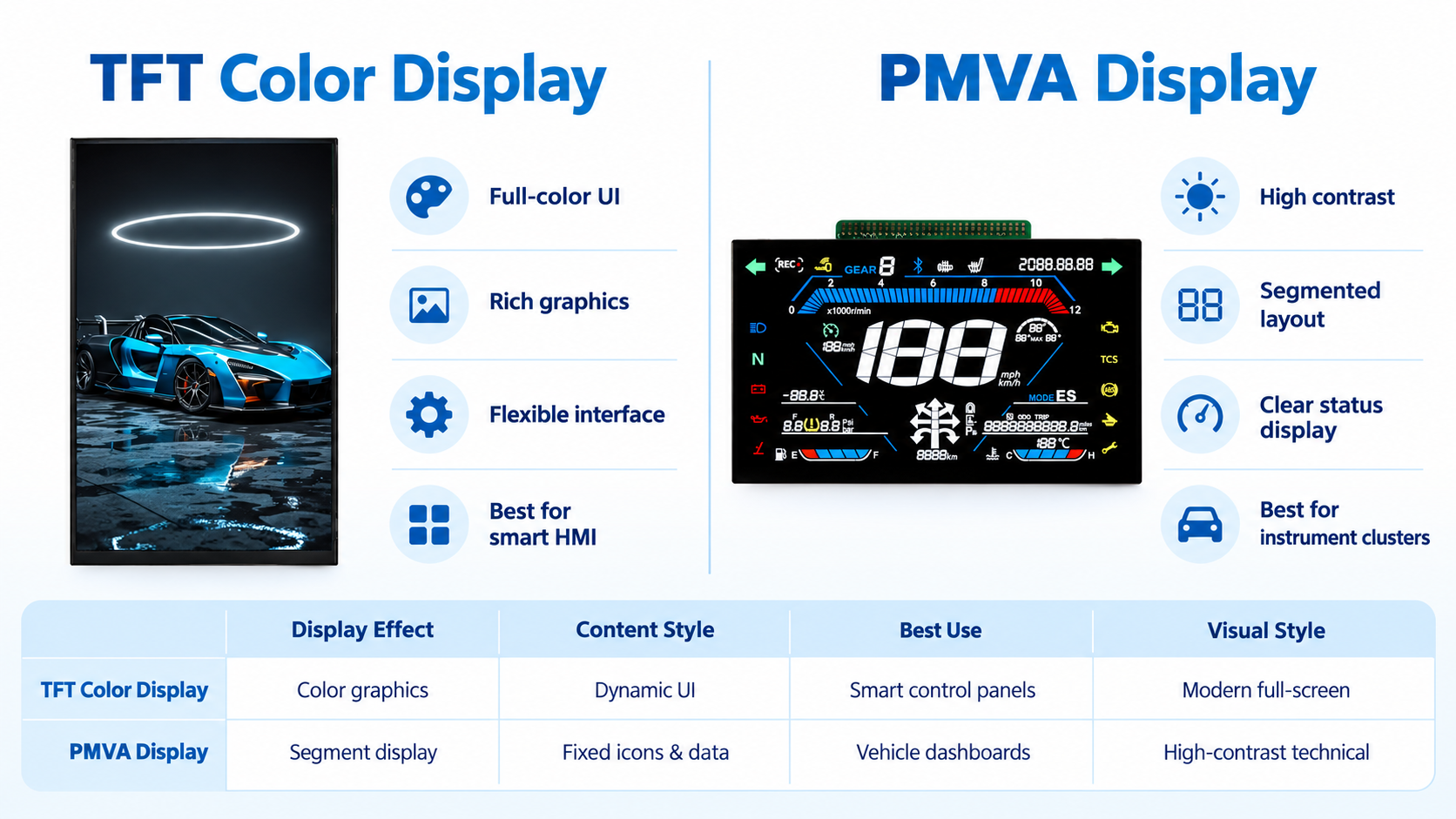
Comparison of TFT color LCD and PMVA segment LCD displays for vehicle dashboards and smart control applications.
03 | VA LCD vs. TFT: What Really Matters?
Display Content
VA segment LCD: Fixed digits, symbols and predefined icons.
TFT LCD: Color images, dynamic menus and flexible graphics.
Power Consumption
VA segment LCD: Often suitable for low-power designs, although backlight requirements affect total consumption.
TFT LCD: Generally requires more power for pixel driving and continuous backlighting.
Customization
VA segment LCD: Custom icon patterns, glass layout, connection structure and backlight options.
TFT LCD: Display modules with project-dependent FPC, interface, touch, cover glass and brightness options.
Development Considerations
VA segment LCD: Requires segment artwork, tooling evaluation and drive-design confirmation.
TFT LCD: Requires interface matching, graphics development and system integration.
The most advanced-looking display is not always the most practical one.
04 | Don’t Compare Screen Prices Alone
Choosing a display also affects the rest of the product.
A VA segment LCD may reduce unnecessary graphical complexity when only fixed information is required.
A TFT LCD may justify its additional system requirements when a richer user experience is essential.
The total project cost can include:
- LCD module and supporting electronics
- Custom tooling and development
- Software and interface integration
- Backlight and power requirements
- Sample validation and production planning
A lower display unit price does not automatically mean a lower overall development cost.
05 | Two Display Technologies, One Manufacturing Partner
At Future Display, we provide both custom monochrome LCD solutions and compact color TFT modules.
With 21 years of industry experience, our manufacturing capabilities include LCD, COG and COB production.
For VA LCD Projects
We can discuss custom display patterns, dimensions, backlight design, connection methods and other project-specific requirements.
For TFT LCD Projects
We support evaluation of suitable display sizes, interfaces, FPC configurations, cover glass and optional touch solutions.
Our OEM/ODM approach begins with understanding the final product rather than recommending one display technology for every application.
Which Display Fits Your Smart Home Product?
If your product mainly displays temperature, timing, battery level or operating status, a custom VA segment LCD may be worth considering.
If it needs colorful graphics, touch controls, multiple menus or a flexible user interface, a TFT LCD may be more suitable.
Still deciding between VA LCD and TFT?
Send Future Display your UI concept, mechanical drawing, interface requirements and expected production quantity.
Our team can review suitable display technologies and customization options for your application.
The best display isn’t always the one with the most features. It’s the one your product actually needs.
Future Display — Custom LCD & TFT Display Solutions
Website: www.future-displays.com
Email: info@futurelcd.com
Post time: Oct-20-2026


