
Two TFT Displays. Similar Specifications. Why Can Their Viewing Experience Be So Different?
Imagine two industrial TFT LCD modules with similar screen sizes, resolutions and brightness specifications.
One uses air-gap bonding. The other uses optical bonding.
Under normal indoor lighting, both may look acceptable. But under strong lighting, their reflections and perceived image contrast can differ.
What causes the difference? And is paying more for full lamination always justified?
The answer depends on the optical structure, application environment, manufacturing requirements and total project cost.
01 | What Is OCA Optical Bonding?
OCA stands for Optically Clear Adhesive.
It generally refers to a preformed transparent adhesive film designed for optical assemblies.
In display manufacturing, OCA can be used to laminate selected layers such as cover glass, a capacitive touch panel and the LCD module.
The adhesive fills the bonding area and reduces the air interfaces between the joined optical layers.
This process is commonly described as optical bonding or full lamination.
However, optical bonding is the process, while OCA is one type of material used in that process.
Other optical bonding approaches may use liquid optical adhesives, often called OCR or LOCA.
Important: OCA film bonding and liquid optical bonding are not identical manufacturing processes.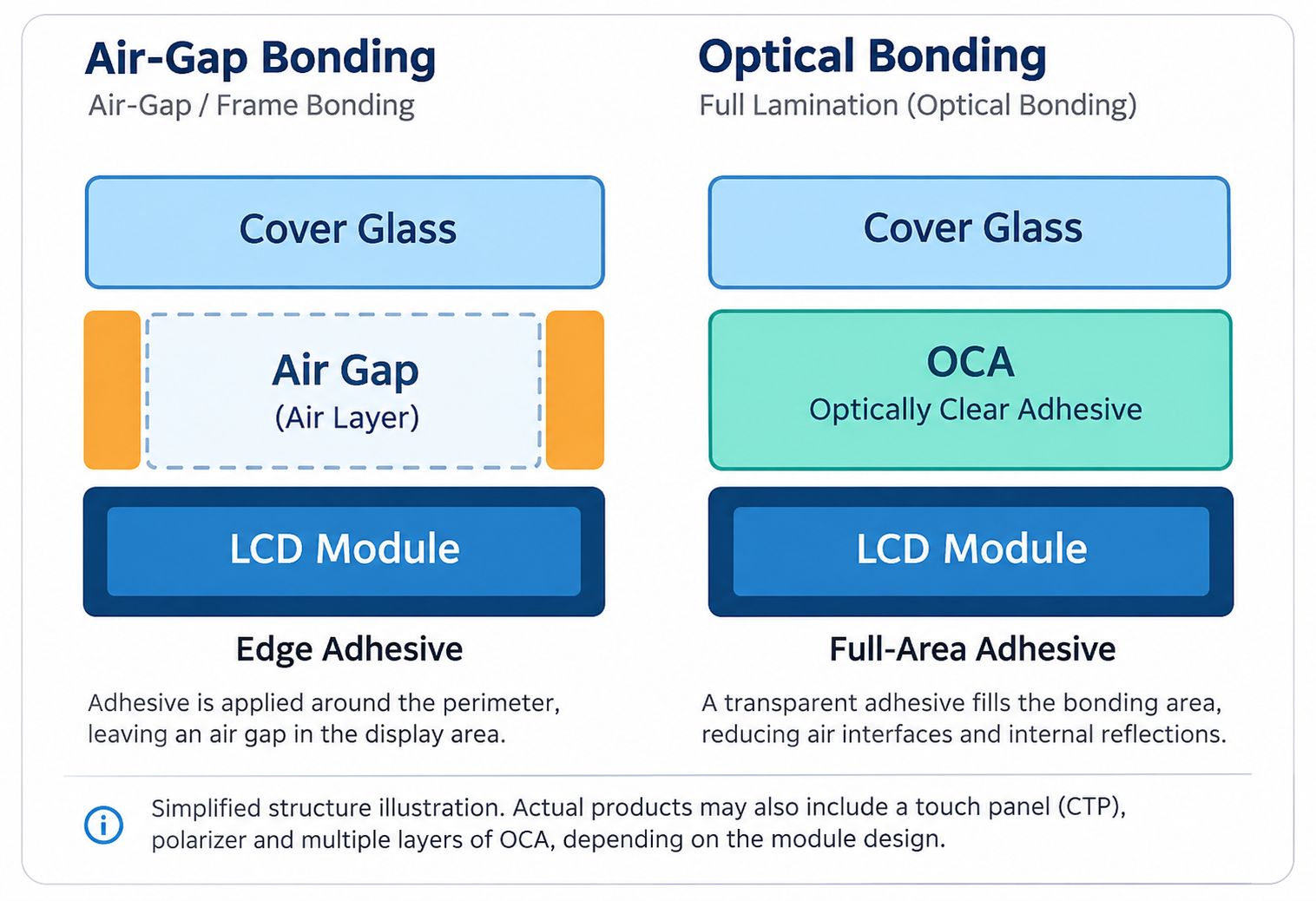
02 | OCA Full Lamination vs. Air-Gap Bonding
The main difference is what occupies the space between the display and the front optical structure.
Air-Gap Bonding
In an air-gap assembly, the cover glass or touch panel is commonly attached around the perimeter using adhesive or a suitable frame structure.
An air space remains between the front structure and the LCD.
This approach can simplify assembly and may support easier servicing or component replacement, depending on the product design.
OCA Full Lamination
With optical bonding, a transparent adhesive fills the selected interface across the bonding area.
Replacing the air gap can reduce reflections at internal surfaces and create a more closely integrated front assembly.
However, the adhesive, materials and lamination process require careful control.
| Feature | OCA Full Lamination | Air-Gap Bonding |
|---|---|---|
| Internal Air Gap | Reduced or eliminated at the bonded interface | Retained |
| Internal Reflections | Generally lower | Generally higher |
| Bright-Light Readability | Can improve perceived contrast | Depends more on other optical measures |
| Assembly Complexity | Higher process-control requirements | Often simpler |
| Rework | Can be more difficult | Often easier |
| Cost | Typically higher | Typically lower |
These are common design tendencies rather than guaranteed results for every material combination.
03 | Why Does OCA Bonding Reduce Reflections?
Light can reflect whenever it travels between materials with different refractive indices.
Air and glass have significantly different refractive indices.
In an air-gap assembly, the additional interfaces can contribute unwanted reflections.
Optical adhesives can be selected with refractive indices closer to the surrounding transparent materials.
By replacing air with a suitable adhesive, certain internal reflections can be reduced.
This may improve the perceived contrast of text, icons and images, especially under demanding lighting conditions.
For outdoor displays, optical bonding should be evaluated together with display brightness, cover-glass coatings and the actual viewing environment.
04 | What Should You Look for in an OCA Bonding Process Video?
An OCA lamination video can help explain the physical steps involved in assembling a TFT touch display.
The precise workflow varies by module construction, equipment and adhesive system, but the following areas are important during engineering review.
Material and Surface Preparation
Particles or contamination on the bonding surfaces can create visible defects and affect adhesion.
Alignment
The cover glass, touch sensor and display area must be aligned according to approved mechanical tolerances.
Lamination Control
Bonding pressure, material properties and equipment settings must be compatible with the display structure.
Bubble Inspection
Inspection should consider visible bubbles, trapped particles, adhesive defects and edge conditions.
Final Display Evaluation
The completed assembly may require visual, optical and functional inspection against the project’s acceptance criteria.
Watch the OCA Bonding Process
See how optical bonding fits into TFT LCD and touch-panel integration.
Insert your verified Future Display manufacturing video here. The technical points above describe general process considerations and do not claim that every step appears in the footage.
05 | Can OCA Bonding Still Develop Bubbles?
Yes. Full lamination reduces the air gap by design, but it does not eliminate every possible manufacturing or material-related defect.
Bubble formation and related issues can be associated with several factors:
- Particles: Contamination trapped between bonding layers.
- Ink Steps: Cover-glass printing steps that challenge adhesive conformability.
- Material Outgassing: Gas release from certain plastic substrates.
- Lamination Conditions: Unsuitable pressure, alignment or process parameters.
- Environmental Stress: Heat and humidity that affect poorly matched materials or bonding systems.
Other concerns can include delamination, optical nonuniformity and yellowing, depending on material selection and exposure.
For LCD modules, bonding stress must also be considered because inappropriate lamination conditions can contribute to display mura.
The goal is not simply to achieve a bubble-free appearance immediately after assembly. The bonding structure should remain acceptable under its intended service conditions.
06 | What Reliability Tests Should Be Considered?
Appropriate validation depends on the selected adhesive, display structure and application.
| Evaluation | Purpose |
|---|---|
| Visual Inspection | Check bubbles, particles, alignment and edge appearance. |
| Optical Evaluation | Review haze, transmission, reflection and display uniformity. |
| High-Temperature Exposure | Investigate adhesive stability under specified heat conditions. |
| Humidity Exposure | Evaluate bubble and delamination risks under moisture stress. |
| Thermal Cycling | Review repeated expansion and contraction effects. |
| UV Aging | Evaluate optical color stability where applicable. |
Test temperature, duration, sample quantity and acceptance criteria should be agreed upon for each project.
These are engineering evaluation options, not a claim that every Future Display module has passed all listed tests.
07 | A Real Future Display Optical Bonding Example
Future Display offers TFT LCD modules with integrated capacitive touch and optical bonding.
One published product is the FUT0500WV20B-ZC-A0, a 5-inch IPS TFT LCD designed for smart home interfaces and industrial HMI applications.
5.0-Inch IPS TFT LCD with Optical Bonding
Model: FUT0500WV20B-ZC-A0
Resolution: 800 x 480
Display Type: IPS TFT LCD
Touch: Capacitive, up to 5-point touch
Bonding: Optical Bonding
Display Interface: 24-bit RGB
Typical Brightness: 300 cd/m²
Operating Temperature: -20°C to +70°C
Applications: Smart home HMI, industrial controllers and embedded control systems
Specifications are based on the published Future Display product page. Final configuration and performance should be confirmed from the approved datasheet.
This model shows how capacitive touch and optical bonding can be integrated into a compact TFT LCD assembly.
With its published 300 cd/m² typical brightness, it should not be presented as a proven direct-sunlight outdoor display without additional optical evaluation.
View the 5-Inch Optical Bonding TFT LCD Product
08 | When Is Full Lamination Worth the Extra Cost?
Optical bonding is often worth evaluating when the application benefits from reduced internal reflections, closer optical integration or a thinner front assembly.
Possible use cases include:
- Outdoor motorcycle and electric vehicle displays
- Industrial HMI panels in brightly lit environments
- Smart home interfaces requiring integrated glass-front designs
- Medical and measurement equipment where optical clarity matters
- Embedded touch products with defined bonding reliability requirements
Air-gap bonding may remain a practical choice for cost-sensitive indoor equipment where the optical advantages of full lamination provide limited additional value.
Before deciding, compare application performance and total assembly requirements, not only the unit price of the bonding process.
09 | Frequently Asked Questions
Is optical bonding always better than air-gap bonding?
No. Optical bonding generally reduces internal reflections, while air-gap bonding can be simpler and less expensive. The better solution depends on the equipment’s optical, mechanical, cost and service requirements.
Does OCA bonding increase LCD brightness?
It does not directly increase LED backlight output. However, reducing some internal reflections and optical losses may improve the brightness and contrast perceived from the completed assembly.
Can bubbles appear after full lamination?
Yes. Bubble resistance depends on adhesive properties, material compatibility, cleanliness, bonding parameters and environmental exposure. Suitable inspection and validation are important.
What is the difference between OCA and OCR or LOCA?
OCA usually refers to a preformed optical adhesive film. OCR or LOCA commonly refers to liquid optical adhesive systems. Both may be used in optical bonding, but their processing methods differ.
Can an optically bonded TFT display be repaired?
Rework may be possible depending on the design and adhesive system, but it is generally more difficult than separating an air-gap assembly. Rework feasibility should be reviewed before production.
Does optical bonding guarantee outdoor readability?
No. Outdoor readability also depends on LCD brightness, ambient reflections, cover glass, display contrast and installation angle.
Can Future Display support customized optical bonding?
Future Display can review TFT LCD, capacitive touch, cover glass and optical bonding requirements for suitable OEM/ODM projects. Final material and structural options depend on engineering feasibility.
10 | Test Your Knowledge: OCA Optical Bonding
Choose an answer first, then open the explanation to check your understanding.
Question 1: What is the main optical difference between full lamination and air-gap bonding?
A. Full lamination automatically doubles screen resolution
B. Full lamination reduces air interfaces between bonded layers
C. Air-gap bonding always provides higher brightness
Show Answer 1
Correct Answer: B. Suitable optical adhesive replaces the air gap and can reduce reflections at internal interfaces.
Question 2: Is OCA the only material used for optical bonding?
A. Yes, all full lamination uses OCA film
B. No, liquid optical adhesive systems also exist
C. No adhesive is required for optical bonding
Show Answer 2
Correct Answer: B. Optical bonding can use OCA film or suitable liquid optical adhesives, depending on the process.
Question 3: Which issue should be checked during OCA process validation?
A. Bubble formation, alignment and optical uniformity
B. Only the screen resolution
C. Only the package color
Show Answer 3
Correct Answer: A. Bonding quality depends on materials, lamination conditions, cleanliness and environmental reliability.
Question 4: Which RFQ information is most useful for selecting OCA or air-gap bonding?
A. Only the preferred adhesive brand
B. Only the target unit price
C. Display structure, glass, application environment, optical needs and quantity
Show Answer 4
Correct Answer: C. A complete RFQ helps engineers compare suitable bonding processes against the application’s requirements.
11 | RFQ: Request a Custom Optical Bonding TFT LCD
Planning a new industrial touch display or upgrading an existing LCD assembly?
Share your project requirements with Future Display using the checklist below.
Optical Bonding TFT LCD RFQ Checklist
1. Application: Industrial HMI / Motorcycle / Medical / Smart Home / Other
2. Display Size and Resolution: Required dimensions and pixel resolution
3. Touch Panel: PCAP / RTP / No Touch
4. Bonding Preference: OCA Film / Liquid Optical Bonding / Air Gap / To Be Evaluated
5. Cover Glass: Thickness, outline dimensions and material
6. Printing Requirements: Black border, ink steps and logo printing
7. Optical Requirements: Brightness, reflections, transmission and haze expectations
8. Operating Conditions: Indoor or outdoor use, temperature and humidity
9. Reliability Requirements: Thermal cycling, humidity, UV or other applicable tests
10. Mechanical and Electrical Requirements: FPC, connector, interface and drawings
11. Purchasing Information: Prototype quantity, annual demand and project schedule
12. Reference Files: LCD datasheet, cover-glass drawing, assembly structure or reference photos
Request Engineering Review & Quotation
Email: info@futurelcd.com
Contact: Contact Future Display
Send your application details, and our team can review suitable bonding and display integration options.
12 | Future Display OEM/ODM Display Integration
Hunan Future Electronics Technology Co., Ltd. supplies TFT LCD modules, monochrome LCD displays and customized display solutions for embedded applications.
Our product portfolio includes modules integrating capacitive touch and optical bonding.
Depending on the selected display platform, our team can review cover glass requirements, touch integration, FPC configurations, display interfaces and applicable bonding options.
Explore our OEM/ODM LCD customization solutions.
Conclusion: Choose the Bonding Method for the Application
OCA full lamination is not simply about adding transparent adhesive to a TFT display.
It is a method of managing optical interfaces, mechanical integration and assembly requirements.
For applications where reflection control and integrated front-panel design matter, optical bonding can provide meaningful benefits.
For cost-sensitive indoor equipment, air-gap bonding may still be the more appropriate solution.
The best choice is the bonding method that meets the actual display performance, reliability, serviceability and budget requirements of your project.
Future Display | Custom TFT LCD and Touch Solutions
Post time: Nov-04-2026


