
A wider viewing angle does not always mean a better display for every machine.
Imagine an industrial control panel installed beside a production machine. The operator can read the screen clearly from the front, but the numbers become harder to distinguish when viewed from the side.
Should you replace the TN TFT LCD with an IPS display?
Not necessarily. The answer depends on how your equipment will be used.
In this guide, we explain how IPS and TN LCD technologies work, compare real Future Display modules, and show what to check before choosing an industrial HMI display.
01 | What Is IPS TFT LCD Technology?
IPS (In-Plane Switching) is an LCD technology designed to provide more consistent image performance across different viewing angles.
In a typical transmissive TFT LCD, the backlight produces light, while liquid crystals and polarizers control how much light reaches the viewer.
IPS uses an electric field that causes liquid crystal molecules to rotate mainly within the plane of the glass substrates.
This arrangement generally reduces the color shifts and gray-scale inversion that can occur when viewing a conventional TN display from an angle.
02 | How Does TN LCD Work?
TN (Twisted Nematic) technology uses liquid crystal molecules arranged in a twisted structure.
When voltage is applied, the molecular orientation changes, affecting the polarization and transmission of light.
TN technology remains useful for many electronic devices, particularly where the operator normally views the screen from a fixed position.
However, some TN displays can exhibit greater contrast changes or gray-scale inversion when viewed from certain directions.
IPS is often preferred for wide viewing requirements, while TN can remain a practical option for fixed-angle applications.
03 | IPS vs. TN: Real 4.3-Inch TFT LCD Examples
Let’s compare two 4.3-inch display modules listed in the Future Display standard product range.

IPS vs TN TFT LCD | Industrial HMI Display Guide
| Specification | TN TFT | IPS TFT |
|---|---|---|
| Model | FUT0430WQ07Q | FUT0430WV42B |
| Display Size | 4.3 inch | 4.3 inch |
| Resolution | 480 x 272 | 800 x 480 |
| Brightness | 350 cd/m² | 350 cd/m² |
| Viewing Angle (U/D/L/R) | 70/70/50/60 degrees | 85/85/85/85 degrees |
| Interface | RGB | RGB |
| Operating Temperature | -20°C to +70°C | -20°C to +70°C |
Source: Future Display published standard product list. Viewing angles follow the listed up/down/left/right order. Specifications and measurement conditions should be confirmed with the latest approved datasheets.
Both modules have a listed brightness of 350 cd/m², but their published viewing-angle specifications differ.
The IPS module offers wider specified angles in all four directions. That can be useful when an operator needs to read the interface from different positions.
However, the two modules also differ in resolution, so this is a product-selection example rather than a controlled laboratory comparison of IPS and TN alone.
Explore additional specifications in the Future Display standard product list.
04 | Is IPS Always Better for Industrial HMI?
Choose IPS when viewing angles are important.
For example, a wall-mounted industrial HMI may need to be viewed from different operator positions. IPS can help improve image consistency in this situation.
Consider TN when the viewing position is fixed.
A compact instrument with a front-facing display may not require the same wide-angle performance. A suitable TN module can still meet the project’s functional and cost requirements.
The decision should be based on the final equipment rather than the display technology name alone.
05 | Four Factors to Check Before Selecting IPS
Viewing Angle and Contrast
Check viewing-angle figures, contrast criteria and the directions from which users will read the screen. An advertised wide viewing angle does not mean that color and contrast remain completely unchanged.
Brightness and Ambient Light
IPS and TN are LCD modes, not brightness ratings. Outdoor or brightly lit equipment may require higher brightness, reflection control or other optical design measures.
Operating Temperature
IPS does not automatically mean wide-temperature operation. Confirm the approved temperature range and evaluate low-temperature response and high-temperature performance when relevant.
PCB and Mechanical Compatibility
Check the interface, driver requirements, FPC routing, connector position, outline dimensions and available installation space before approving the module.
06 | Common Questions About IPS TFT LCDs
Does IPS always provide a 178-degree viewing angle?
No. Actual viewing-angle specifications depend on the panel and the measurement criteria. Always check the individual module datasheet.
Is IPS brighter than TN?
Not necessarily. Brightness depends on backlight output, panel transmission and the complete optical structure. Two modules can have the same brightness but different viewing-angle characteristics.
Does IPS consume more power?
Power consumption depends on the panel, backlight and driving configuration. The complete module specifications should be compared rather than making assumptions based on LCD mode alone.
Can IPS TFT LCD modules be customized?
Depending on the selected display platform, customization may involve the FPC, touch panel, cover glass, backlight or mechanical integration. Feasibility must be reviewed for each project.
07 | How Future Display Supports Industrial TFT Projects
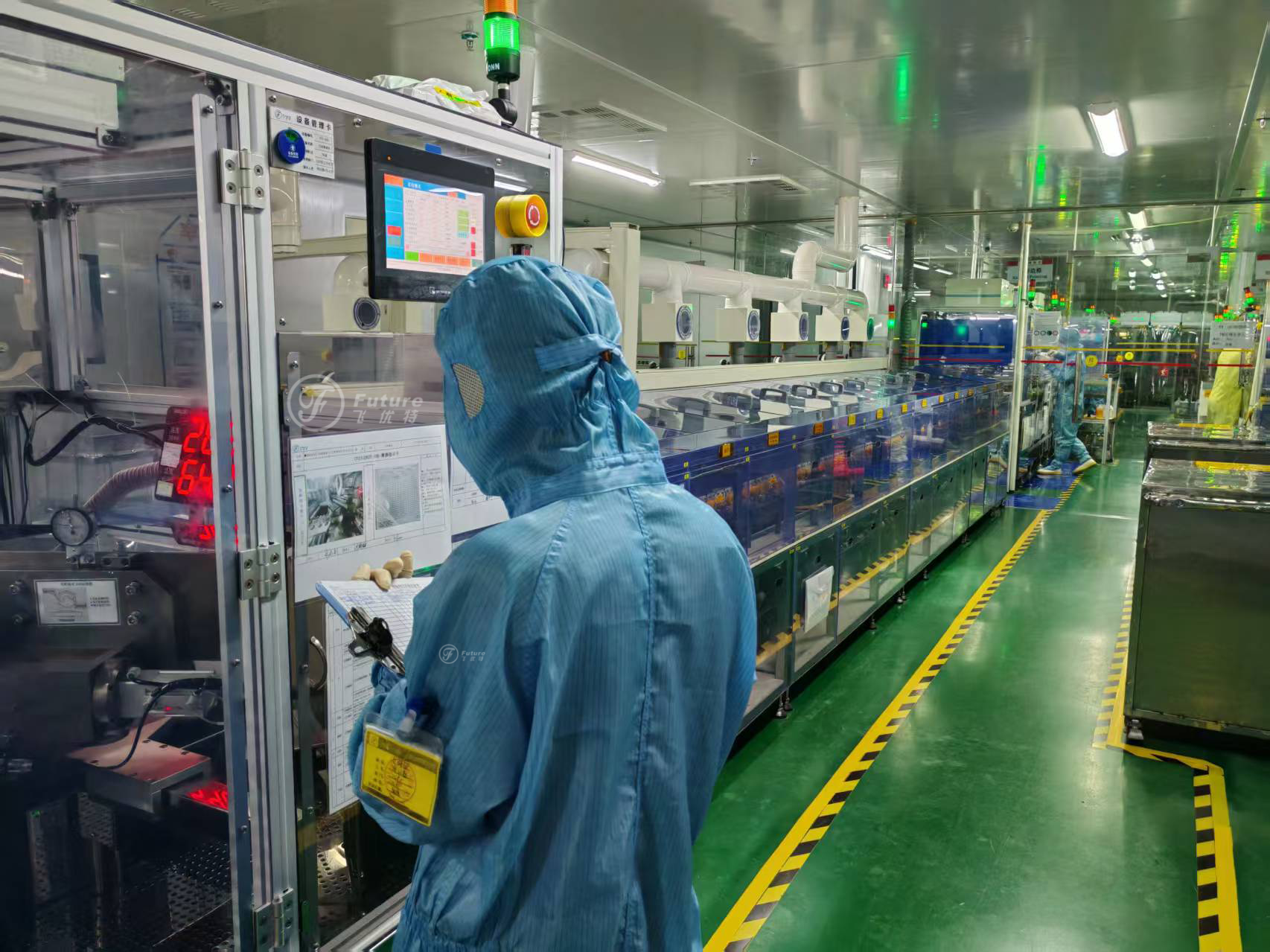
With display manufacturing experience since 2005, Hunan Future Electronics Technology Co., Ltd. supplies TFT LCD modules and customized display solutions for embedded equipment.
Our available TFT portfolio includes different display sizes, resolutions, interface types and LCD modes.
We support project-dependent engineering review for:
- IPS and TN TFT LCD selection
- Display brightness and viewing requirements
- FPC and interface compatibility
- Capacitive or resistive touch options
- Cover glass and optical bonding requirements
- Sample evaluation and production planning
See our TFT LCD module range for additional display options.
hoose the Viewing Experience Your Equipment Needs
IPS can be an excellent choice for industrial HMI applications requiring consistent visibility from different angles.
TN may still be appropriate for products with fixed viewing positions and other specific design priorities.
The right LCD is not necessarily the one with the widest specification. It is the one that meets the complete equipment requirements.
Need Help Choosing an Industrial TFT LCD?
Send us your display size, interface, viewing-angle requirements, installation drawing and expected order quantity.
Our team can review suitable IPS or TN TFT LCD options and discuss available customization.
Email: info@futurelcd.com
Website: Contact Future Display
Let’s find a display that works from your customer’s actual viewing position.
Post time: Nov-03-2026


