
AG vs. AR vs. AF: Which Cover Glass Treatment Is Best for Motorcycle TFT LCDs?
1. Introduction
For motorcycle TFT LCD displays, visibility and durability are essential considerations.
A display may offer high brightness, but reflections from sunlight can still make important information difficult to read. Fingerprints, dust, and repeated cleaning can also affect the appearance of the cover glass.
Three common surface treatments help address these challenges: AG (Anti-Glare), AR (Anti-Reflection), and AF (Anti-Fingerprint).
Although these technologies are often mentioned together, they serve different purposes.
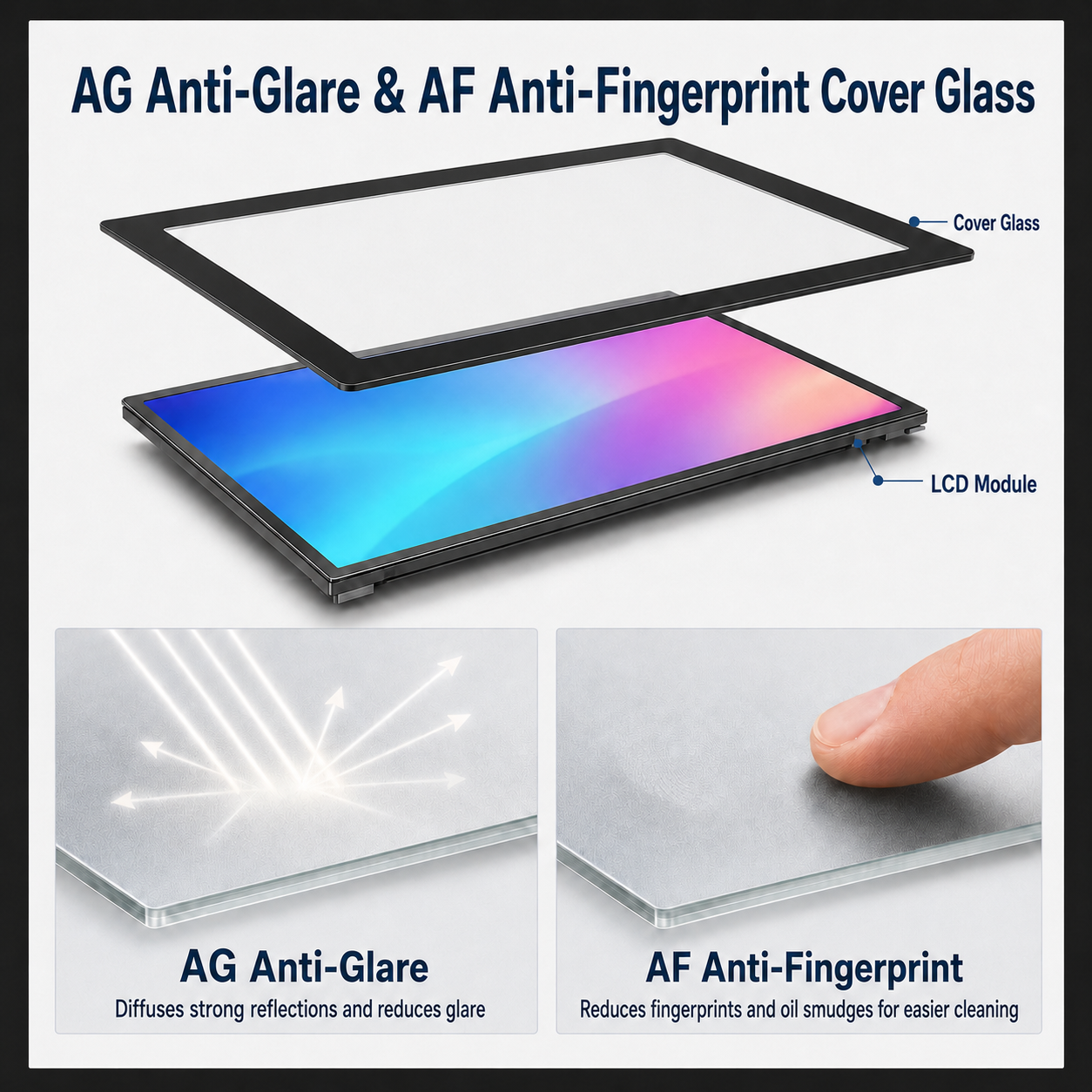
- AG reduces distracting mirror-like reflections by scattering reflected light.
- AR reduces surface reflectance through optical coating technology.
- AF improves resistance to fingerprints and makes the glass easier to clean.
Understanding their differences helps engineers select a suitable cover glass for motorcycle dashboards, industrial HMI systems, and other display applications.
2. AG Glass: Reducing Glare Without Sacrificing Clarity
Imagine riding a motorcycle on a sunny afternoon. The digital dashboard is bright, but reflections from the sky make the speed and warning indicators difficult to see.
This is where AG glass can help.
Anti-Glare glass uses surface microstructures or specialized coatings to scatter reflected light, reducing the intensity of mirror-like reflections.
However, stronger anti-glare treatments may increase haze and affect perceived image clarity.
Engineers should consider the following parameters:
- Haze: The degree of light scattering.
- Gloss: The appearance of surface reflections.
- Clarity: How clearly fine details remain visible.
- Sparkle: Grainy visual artifacts that may appear when AG surfaces interact with display pixels.
Customer Question: Will AG glass make the display blurry?
Some AG treatments may affect image clarity, especially when haze is high. The right solution requires balancing glare reduction with the visibility of text, graphics, and warning indicators.
3. AR Coating: Reducing Reflections Through Optical Design
AR stands for Anti-Reflection.
Unlike AG, which scatters reflected light, AR coatings are designed to reduce the amount of reflected light.
AR technology commonly uses thin-film optical interference. By carefully selecting coating materials and thicknesses, reflections from different interfaces can partially cancel one another.
This helps reduce surface reflectance while maintaining image clarity.
However, AR performance depends on several factors, including wavelength, viewing angle, coating structure, and the complete cover-glass assembly.
Customer Question: Is AR always better than AG for outdoor displays?
Not necessarily.
AR can be a strong option when low reflectance and image clarity are priorities. AG may be useful when reducing distinct mirror-like reflections is the main objective.
The best choice depends on the display application, optical requirements, durability, and budget.
4. AF Coating: Keeping Touchscreens Cleaner
AF stands for Anti-Fingerprint.
AF coatings commonly use low-surface-energy materials to reduce the spreading or adhesion of fingerprint oils and improve cleaning.
For motorcycle dashboards, this can be useful when riders frequently touch the display or wipe away dirt and fingerprints.
However, AF does not make a screen completely fingerprint-proof.
Its performance may gradually change through repeated friction, abrasion, or exposure to unsuitable cleaning chemicals.
Customer Question: Will operating a touchscreen with gloves damage the AF coating?
Repeated glove contact does not automatically damage the coating. The risk depends on factors such as glove material, contact pressure, abrasive particles, and coating durability.
It is also important to distinguish AF coating durability from glove-touch functionality. A touchscreen’s ability to detect gloves depends mainly on the touch sensor and controller, not the AF coating.
5. AG vs. AR vs. AF: Key Differences
| Feature | AG | AR | AF |
|---|---|---|---|
| Full name | Anti-Glare | Anti-Reflection | Anti-Fingerprint |
| Main purpose | Reduce visible glare | Reduce reflectance | Reduce smudging |
| Principle | Light scattering | Thin-film interference | Low-surface-energy coating |
| Key parameters | Haze, clarity, sparkle | Reflectance, wavelength, angle | Oleophobicity, abrasion |
| Main concern | Image clarity | Coating performance and cost | Surface durability |
| Typical use | Bright environments | Low-reflection displays | Frequently touched displays |
These treatments are not competing performance grades. They can complement one another.
For example, a motorcycle TFT LCD used outdoors may benefit from combining glare management, low reflectance, and fingerprint resistance.
However, combined treatments require optical, mechanical, and environmental validation.
6. Can AG, AR, and AF Be Combined?
Yes. Compatible AG, AR, and AF treatments can be combined on selected cover-glass structures.
For example, an outdoor motorcycle dashboard may require reduced reflections, clear visual information, and a surface that is easy to clean.
Depending on the application, engineers may evaluate AG+AF, AR+AF, or AG+AR+AF configurations.
The final design should consider optical performance, coating compatibility, abrasion resistance, cleaning requirements, and manufacturing cost.
More coatings do not automatically mean better overall performance.
7. Future Display Motorcycle TFT LCD Solutions
Future Display provides customized TFT LCD modules for motorcycle instrument clusters and industrial applications.
One example is the FUT0700SV127Q-ZC-A0, a 7-inch motorcycle TFT LCD module featuring:
- 7.0-inch display
- 1024 × 600 resolution
- 1000+ nits brightness
- RGB 24-bit interface
- Operating temperature from -30°C to +85°C
For suitable projects, Future Display can review AG and AF cover-glass requirements, including dimensions, surface treatment, touch integration, and optical bonding.
If AR coating is required, its feasibility and specific optical performance should be evaluated with the engineering team.
8. Frequently Asked Questions
Q1. What is the main difference between AG and AR?
AG scatters reflected light to reduce distracting glare, while AR reduces surface reflectance through optical design.
Q2. Does AG glass reduce display sharpness?
Some AG treatments may increase haze or sparkle and affect perceived image clarity. The final result depends on the glass and display assembly.
Q3. Does AR coating increase LCD brightness?
AR does not increase LED backlight output. It reduces certain reflections and may improve the optical transmission and readability of the completed display.
Q4. Can AG, AR, and AF be applied together?
Yes, compatible treatments may be combined, but their performance and manufacturing feasibility must be evaluated.
Q5. Does AF coating support glove touch?
No. Glove-touch capability depends mainly on the touch sensor, controller, and system configuration.
Q6. Can Future Display provide customized cover-glass solutions?
Future Display can review cover-glass dimensions, AG/AF treatments, optical bonding, and other display integration requirements. Specific AR options require further engineering confirmation.
9. How to Choose the Right Cover Glass
Before choosing a surface treatment, manufacturers should consider several questions.
What lighting conditions will the display face? Is reducing glare more important than maintaining maximum image clarity? Will users frequently touch the surface or clean it with chemicals? Are there specific reflectance, abrasion, or environmental requirements?
These questions help determine whether AG, AR, AF, or a combination is appropriate.
For customized display projects, customers should provide the application, display dimensions, required surface treatments, optical performance targets, cleaning conditions, and estimated purchase volume.
Contact Future Display
Website: https://www.future-displays.com/
Email: info@futurelcd.com
10. Conclusion
AG, AR, and AF are three different technologies that improve the user experience of TFT LCD displays.
AG reduces distracting reflections by scattering light. AR reduces surface reflectance through optical coating technology. AF helps reduce fingerprints and makes the surface easier to clean.
For motorcycle displays, the right solution depends on sunlight conditions, image clarity, touch requirements, durability, and cost.
The best cover glass is not necessarily the one with the most coatings, but the one that meets the actual requirements of the application.
Post time: Nov-20-2026


